Northern Kenya’s Samburu region is a hidden gem for wildlife photographers seeking unique and rare species. Home to the elusive “Samburu Special Five,” this semi-arid landscape offers distinct photographic opportunities you won’t find in southern Kenya’s more trafficked parks. Here’s how to capture these fascinating animals and where to find them.
Who are the Samburu Special Five?
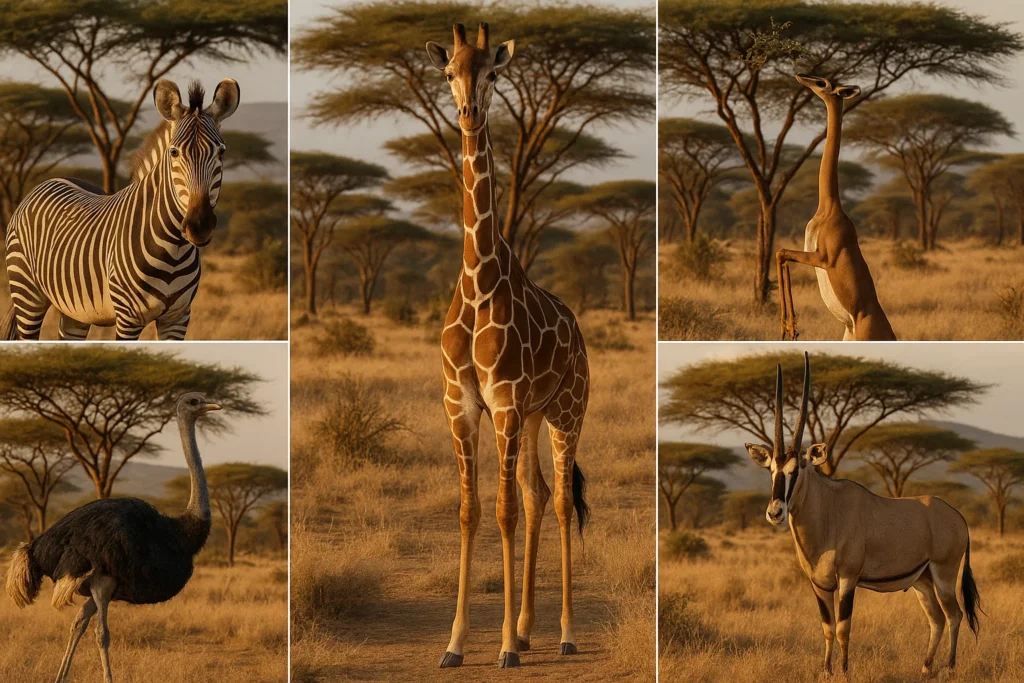
The Samburu Special Five are:
- Grevy’s zebra – the largest and rarest zebra species with thin stripes and large, rounded ears.
- Reticulated giraffe – known for its bold, net-like coat pattern.
- Beisa oryx – a desert-adapted antelope with long straight horns.
- Gerenuk – the “giraffe gazelle” that stands on hind legs to browse.
- Somali ostrich – with bright blue neck and legs, distinct from the common ostrich.
These species are specially adapted to the arid environment of Samburu and are difficult to spot in other parts of East Africa.
Best places to photograph the Special Five
- Samburu National Reserve: The core area for sightings, especially around the Ewaso Ng’iro River.
- Buffalo Springs & Shaba Reserves: Adjacent reserves that offer the same species with fewer vehicles.
- Kalama and Westgate Conservancies: Community-managed lands with more freedom for off-road photography.
Local guides are essential—they know the animals’ patterns and help position you for optimal light and composition.
Tips for photographing each species
Grevy’s zebra
- Best shot at waterholes or grazing in open plains.
- Use side lighting to highlight their fine striping.
- Capture interactions—foals, dust clouds, or zebra herds.
Reticulated giraffe
- Look for them near acacia trees.
- Silhouettes at sunrise or sunset work well.
- Use wide-angle lenses to emphasize height and environment.
Beisa oryx
- Often found in dry scrub—watch for small groups.
- Backlighting can make their horns stand out.
- Be patient—they’re shy and skittish.
Gerenuk
- Best found browsing acacia in the mornings.
- Wait for the iconic upright feeding pose.
- Shoot from a lower angle to elongate their stance.
Somali ostrich
- Open plains are ideal—look for males with vibrant blue coloring.
- Motion shots work well as they run.
- Use burst mode for wing displays.
Recommended gear
- Telephoto lens (300–400mm): For distant or shy subjects.
- Wide-angle lens (16–35mm): For environmental portraits and giraffe.
- Bean bag: More stable than a tripod in safari vehicles.
- Dust protection: Samburu is dry and sandy—keep gear clean.
- Extra batteries & cards: Remote areas mean no quick restocks.
Best time to go
- Dry season (July to October): Sparse vegetation and reliable sightings.
- Green season (November to March): Dramatic skies, more vibrant backdrops, and baby animals.
- Golden hours (6–9 AM, 4–6 PM): Ideal light and animal activity.
Ethical photography in Samburu
- Don’t approach too closely or pressure wildlife.
- Respect local communities and ask before photographing people.
- Choose eco-lodges and guides that support conservation and ethical tourism.
Conclusion
Photographing the Samburu Special Five offers a rewarding and distinctive safari experience. From the geometrically patterned giraffes to the blue-legged ostrich, each species tells a visual story of adaptation and survival. With the right timing, gear, and guidance, you’ll leave Samburu with a stunning portfolio—and a deep respect for this remarkable corner of Kenya.
FAQs
Yes, with 2–3 days in Samburu, most travelers spot all five species.
Often yes—conservancies allow off-road driving and fewer crowds.
Absolutely. The region is home to over 350 bird species.
Strongly recommended—they greatly increase your chances of quality sightings and shots.
Harsh light and dust. Plan for golden hours and protect your gear.