Few natural phenomena capture the imagination like African wildlife migrations. Vast herds moving in rhythm with the seasons, birds crossing continents, and animals following invisible environmental cues have shaped Africa’s ecosystems for millennia. But today, these ancient movements are being quietly — and profoundly — disrupted.
Climate change is altering when, where, and how animals move across Africa, reshaping migration patterns that once seemed timeless. This is not just a wildlife issue; it’s an ecosystem-wide shift with cascading consequences.
This article explores how climate change is affecting African wildlife migration at a systemic level, focusing on behavior, timing, routes, and ecological balance — not individual species lists or tourism highlights.
Migration in Africa: More Than Movement
Migration is not random travel. In African ecosystems, it is a precise survival strategy, evolved to track:
- Seasonal rainfall
- Fresh grazing and vegetation growth
- Water availability
- Breeding conditions
- Predator pressure
From savanna herbivores to soaring birds, migration synchronizes life with climate. When climate patterns shift, the logic of migration breaks down.
Climate Change Is Disrupting the Signals Animals Depend On
Rainfall Is Less Predictable
Historically, African rainfall followed relatively reliable seasonal patterns. Climate change is now causing:
- Delayed rainy seasons
- Shorter but more intense rainfall events
- Longer and harsher droughts
- Increased variability year to year
Migratory animals rely on rain-triggered vegetation growth. When rains come late, early, or not at all, herds may arrive to landscapes that look green but lack nutritional value, or miss peak grazing windows entirely.
Shifting Timing: When Migration Falls Out of Sync
One of the clearest impacts of climate change is phenological mismatch — when animals move at the “wrong” time relative to environmental conditions.
What’s changing:
- Grazers arrive before grass has recovered
- Calving occurs when food quality is poor
- Birds reach breeding grounds after peak insect abundance
These mismatches reduce survival rates, especially for young animals, even if migration routes themselves remain intact.
Changing Routes and Broken Corridors
Climate stress does not act alone. It compounds existing pressures such as habitat fragmentation and human land use.
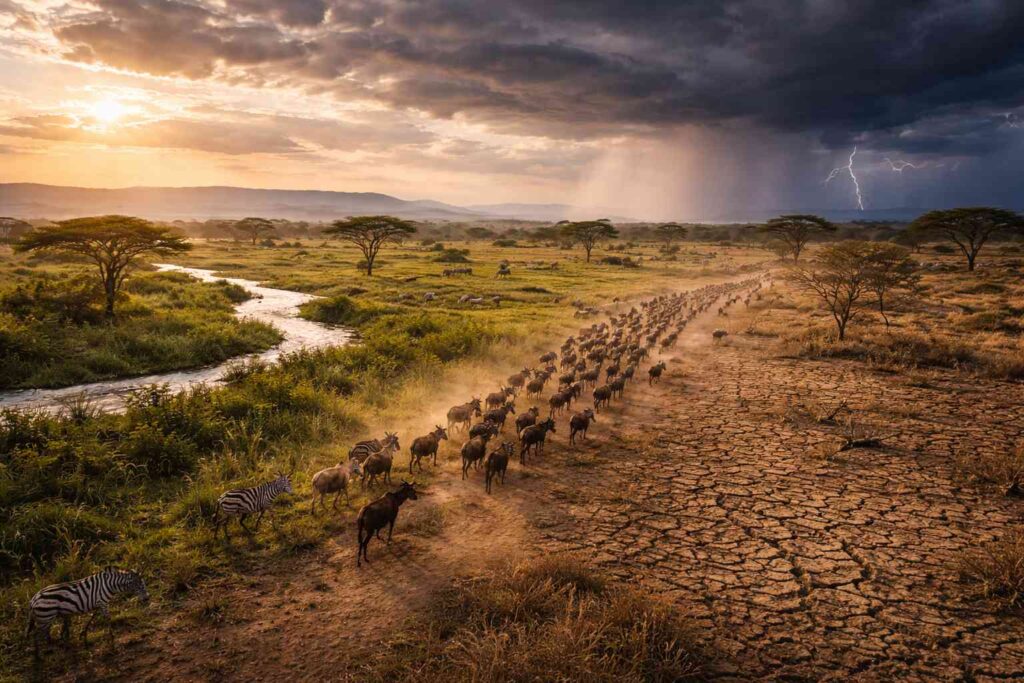
As water sources dry up or shift location:
- Traditional migration corridors become unusable
- Animals detour into suboptimal or dangerous areas
- Human–wildlife conflict increases
What once were broad, flexible movements are now narrowed and constrained, reducing animals’ ability to adapt dynamically to changing conditions.
Water as the New Migration Driver
In many African ecosystems, water availability is overtaking grass quality as the primary driver of movement.
Climate change has led to:
- Drying seasonal rivers
- Reduced wetland flooding
- Fewer reliable water points
Animals increasingly cluster around remaining water sources, leading to:
- Overgrazing
- Soil degradation
- Increased disease transmission
- Higher predation pressure
This concentration effect fundamentally alters migration dynamics, turning wide-ranging movements into localized survival bottlenecks.
Birds: Migration at Continental Scale Under Pressure
Migratory birds are among the most climate-sensitive animals because their journeys span continents.
Climate change affects them by:
- Altering wind patterns and thermal currents
- Drying wetlands used as stopover sites
- Shifting insect emergence timing
- Increasing extreme weather events
When even one link in a migratory chain fails, entire populations can decline — even if breeding grounds remain intact.
From Migration to Partial Migration — or None at All
In some regions, animals are responding by changing strategy entirely.
Emerging patterns include:
- Shorter migrations
- Partial migration (only some individuals move)
- Year-round residency where movement once occurred
While this may seem adaptive, it often comes at a cost:
- Increased competition
- Reduced genetic mixing
- Greater vulnerability to drought and disease
Migration evolved as a solution to variability. Climate change is now making variability too extreme or too unpredictable for migration to function effectively.
Ecological Consequences Beyond the Migrants
Migration is a keystone process. When it changes, entire ecosystems respond.
Cascading effects include:
- Altered grazing pressure and vegetation structure
- Changes in fire regimes
- Nutrient flow disruption across landscapes
- Predator-prey imbalances
In Africa, many ecosystems evolved around movement, not permanence. When movement fails, ecosystem health often follows.
Adaptation Is Happening — But There Are Limits
African wildlife has survived past climate shifts, but the speed of current change is unprecedented.
Animals can adapt by:
- Adjusting timing
- Altering routes
- Changing diet
- Increasing behavioral flexibility
However, adaptation has limits — especially when climate change intersects with fences, farms, roads, and expanding human settlement.
What This Means for the Future
Climate change is not “ending” migration — but it is reshaping it.
Future African migrations are likely to be:
- More irregular
- More localized
- More risky
- More dependent on intact landscapes
Protecting migration in a warming world means focusing not only on animals, but on:
- Climate-resilient landscapes
- Water security
- Large-scale connectivity
- Flexibility rather than fixed patterns
What This Means for Safari Travelers
For travelers, these changes may be subtle at first:
- Migrations may arrive earlier or later
- Wildlife distributions may look different year to year
- Some areas may feel quieter while others become crowded
Understanding climate-driven change transforms safaris from static expectations into living, evolving systems — and deepens appreciation for what is at stake.
Conclusion: Migration as a Climate Barometer
African wildlife migration is one of the planet’s most sensitive indicators of climate change. When animals move differently, they are telling us something fundamental about how landscapes are changing.
Climate change is not only warming Africa — it is rewriting the rules of movement that have governed ecosystems for thousands of years. The future of migration will depend on how well nature is allowed to adapt — and how wisely humans respond.
To keep exploring Africa through the lens of ecology, systems, and environmental change, continue through the blog — this is where the deeper stories unfold.
Frequently Asked Questions (FAQs)
Yes. Changes in timing, routes, and migration success are already being observed across multiple ecosystems.
No. Highly specialized migrants and long-distance birds are often more vulnerable than flexible generalists.
Some adaptation is occurring, but rapid climate shifts combined with habitat fragmentation limit long-term resilience.
Yes. Predators depend on migratory prey and are affected when migration patterns change.
In some areas, migrations are shrinking or becoming partial, but most are changing rather than vanishing outright.
Human-driven climate change and land use both intensify pressure on migratory systems.