When travelers think about African wildlife, the focus often falls on iconic sightings: lions at dawn, elephants crossing rivers, or herds stretching to the horizon. But beneath these unforgettable moments lies a deeper ecological reality. Africa’s landscapes are not held together by numbers or spectacle alone — they are shaped by keystone species.
A keystone species is one whose impact on an ecosystem is far greater than its population size would suggest. Remove it, and the system doesn’t simply lose a component — it can unravel, shift, or collapse entirely. In Africa, where ecosystems are dynamic, seasonal, and interconnected, keystone species act as regulators, engineers, and stabilizers.
This article explores the concept of keystone species from a systemic, ecological perspective, moving beyond famous animal lists to understand how ecosystems actually work.
What Is a Keystone Species? (The Ecological Core)
In ecology, a keystone species is defined by function, not popularity. Its presence determines:
- Which species thrive or decline
- How vegetation grows
- How nutrients move through land and water
- How energy flows across the food web
The term comes from architecture: remove the keystone from an arch, and the entire structure collapses. In nature, the collapse may be slower — but the outcome is just as profound.
Africa’s savannas, floodplains, forests, and deserts are especially sensitive to keystone species because they rely on balance rather than stability. Rainfall, fire, grazing, and predation constantly reshape the land — and keystone species are the ones steering that change.
Elephants: The Ultimate Ecosystem Engineers
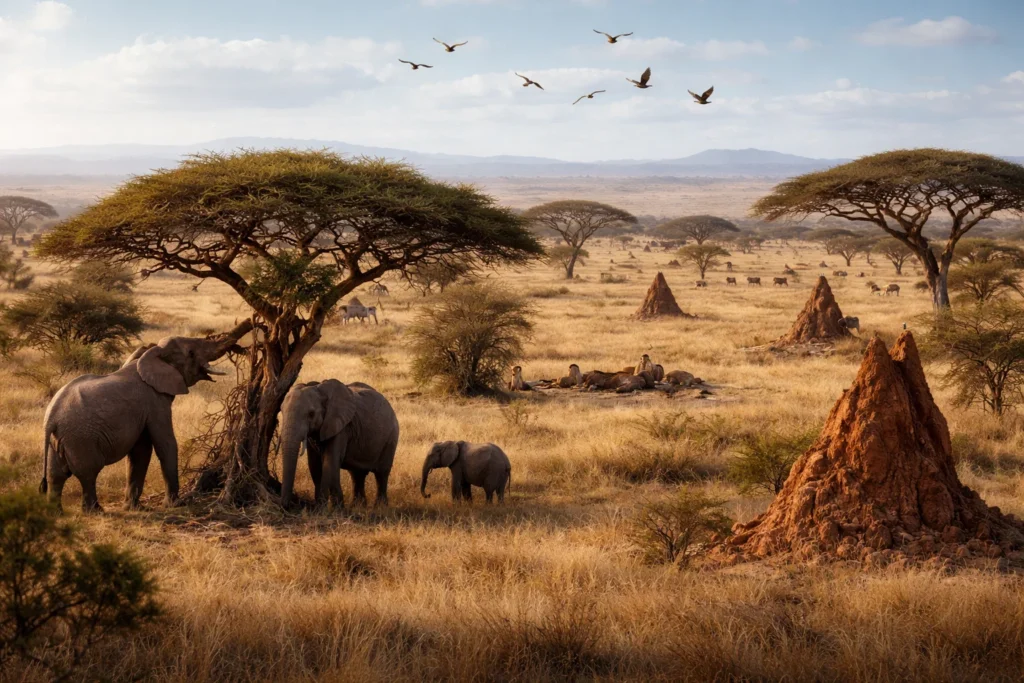
African elephants are among the clearest and most powerful keystone species on the continent.
How elephants shape ecosystems
- Vegetation control: By uprooting trees and feeding on woody plants, elephants prevent savannas from turning into dense forests.
- Water access: In dry regions, elephants dig into sandy riverbeds, creating water points used by many other animals.
- Seed dispersal: Elephants move seeds across vast distances, often depositing them with natural fertilizer.
System-wide effects
Without elephants:
- Grasslands shrink
- Fire regimes change
- Grazing species decline
- Biodiversity drops
Elephants don’t merely live in ecosystems — they define the structure of entire landscapes.
Apex Predators: Regulating From the Top Down
Large predators are keystone species because they regulate ecosystems indirectly as much as directly.
Their ecological role
- Control herbivore populations
- Prevent overgrazing
- Remove weak or diseased individuals
- Alter prey behavior
This creates what ecologists call a landscape of fear — prey animals move more, graze less intensively, and avoid sensitive areas like riverbanks.
Trophic cascades
When predators disappear:
- Herbivores overbrowse vegetation
- Soil erosion increases
- Tree regeneration fails
- Insects, birds, and small mammals decline
Predators don’t need to kill frequently to matter — their presence alone reshapes ecosystems.
Hippos: Linking Land and Water Systems
Hippos are one of Africa’s most underappreciated keystone species.
Why hippos matter
- Graze on land at night
- Spend days in rivers
- Transport nutrients from grasslands into aquatic systems through dung
This nutrient flow fuels:
- Algae growth
- Aquatic insects
- Fish populations
- Birds and crocodiles
In many African rivers, entire food webs depend on hippo-driven nutrient cycles. Remove hippos, and rivers often become clearer — but biologically poorer.
Rhinos: Quiet Shapers of Grasslands
Rhinos are rarely discussed as ecosystem drivers, yet their impact is subtle and far-reaching.
Ecological contributions
- Selective grazing creates short-grass “lawns”
- These lawns attract certain grazers
- Dung middens concentrate nutrients and seeds
- Grass species composition shifts over time
White rhinos, in particular, help maintain open grazing systems that support diverse herbivore communities.
Termites: Small Creatures, Massive Influence
Keystone species aren’t always large or charismatic.
Termites are among the most important ecosystem engineers in Africa.
Why termite mounds matter
- Aerate compacted soils
- Improve water infiltration
- Concentrate nutrients
- Create fertile islands in poor soils
Around termite mounds:
- Trees grow taller
- Plant diversity increases
- Herbivores gather
- Predators follow prey
These effects are so strong that termite mounds influence vegetation patterns visible from space.
Vultures: Invisible Guardians of Ecosystem Health
Vultures are keystone species because of what they remove, not what they add.
Their role
- Rapid carcass consumption
- Disease prevention
- Limiting feral scavenger populations
- Maintaining sanitation across landscapes
Where vultures decline:
- Carcasses linger
- Disease risk increases
- Feral dogs and rats expand
- Human–wildlife conflict rises
Their ecological service is often invisible — until it disappears.
Keystone Species vs. Iconic Species
Not all famous animals are keystone species, and not all keystone species are famous.
| Concept | Focus |
|---|---|
| Iconic species | Cultural and tourism value |
| Keystone species | Structural ecological role |
| Visibility | Often low |
| Impact | Ecosystem-wide |
This distinction matters deeply for conservation and education.
Why Keystone Species Matter for Conservation
Protecting keystone species:
- Preserves entire ecosystems
- Maximizes biodiversity protection
- Supports ecosystem services humans rely on
- Increases resilience to climate change
In Africa, losing a keystone species often triggers ecological collapse long before extinction is obvious.
What This Means for Safari Travelers
Understanding keystone species changes how you experience a safari:
- An elephant breaking a tree is not destruction — it’s design
- A lion resting is still shaping behavior
- A termite mound is a fertility engine
- A vulture overhead is preventing disease you’ll never see
Safaris become ecological stories, not just sightings.
Conclusion: Seeing Africa as a Living System
Africa’s wild landscapes are not static backdrops — they are living systems shaped by key players. Keystone species act as architects, regulators, and engineers, holding ecosystems together through complex, often invisible processes.
When we move beyond checklists and start asking how nature works, our understanding of Africa deepens — and so does our responsibility to protect it.
Explore more ecological perspectives across the blog to see Africa not just as a destination, but as a functioning, fragile, and extraordinary system.
Frequently Asked Questions (FAQs)
No. Keystone species can be small, including insects or birds, as long as their ecological impact is disproportionate.
No. Keystone roles vary by ecosystem — savanna, forest, wetland, and desert systems each rely on different species.
Yes. In many ecosystems, human activity now functions as a keystone force — often with negative consequences.
Changes often happen gradually, creating “ecological debt” that becomes visible years later.
Yes. Climate change, species introductions, and extinctions can shift which species play keystone roles.
No. Herbivores, scavengers, and even insects can be keystone species.
Yes. Ecosystem health also depends on interactions among many species, not single solutions.