When most travelers think of Amboseli National Park, giant elephant herds and postcard-perfect views of Mount Kilimanjaro usually come to mind. Yet hidden among the park’s open plains is another fascinating story—one of survival, adaptation, and coexistence. Amboseli’s lions may not be as numerous as those in Kenya’s Masai Mara or Tanzania’s Serengeti, but they play a vital role in one of East Africa’s most studied ecosystems.
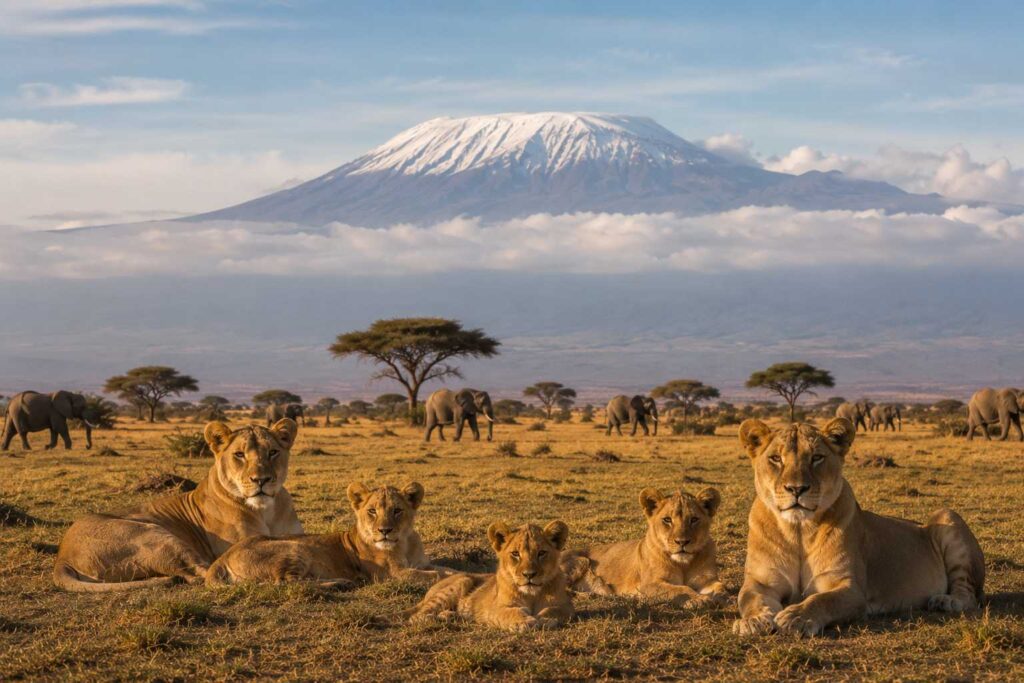
For visitors lucky enough to encounter them, seeing a pride of lions against the backdrop of Africa’s highest mountain is an unforgettable safari experience. Understanding how these predators live, hunt, and interact with both wildlife and local communities adds even greater meaning to every sighting.
How many lions live in Amboseli?
Amboseli supports a relatively small but important lion population compared with some of East Africa’s larger ecosystems.
Unlike the vast predator populations of the Serengeti or Masai Mara, lions in Amboseli live in a more fragmented landscape where the national park itself forms only one part of a much larger ecosystem. Many prides move beyond the park boundaries into surrounding Maasai community lands and wildlife conservancies.
Because lions regularly cross these boundaries, population numbers naturally fluctuate over time.
Rather than focusing on a specific count, conservationists pay closer attention to long-term trends, pride dynamics, and the survival of individual lions.
Why Amboseli has fewer lions than other parks
Several factors influence the park’s predator population.
These include:
- A relatively small protected area
- Seasonal wildlife movements
- Human-wildlife coexistence
- Livestock grazing around park boundaries
- Natural competition with other predators
Unlike fenced reserves, Amboseli functions as an open ecosystem where wildlife moves freely across a much larger landscape.
This makes effective conservation dependent not only on protecting the national park itself but also on maintaining healthy wildlife corridors beyond its borders.
Lion prides in Amboseli
Amboseli’s lions live in social groups known as prides.
A typical pride may include:
- Related adult females
- Cubs of different ages
- One or more dominant males
- Subadult offspring
Female lions usually remain within the same pride throughout their lives, while young males eventually leave to establish or take over territories elsewhere.
Because territories overlap with neighboring community lands, individual lions often travel considerable distances beyond the park.
Hunting in the Amboseli ecosystem
The park’s open grasslands provide excellent visibility for both predators and prey.
Lions typically hunt:
- Blue wildebeest
- Plains zebras
- Grant’s gazelles
- Thomson’s gazelles
- Buffalo calves
- Young giraffes on occasion
Most hunting takes place during the cooler hours of the evening, night, or early morning.
Female lions perform most of the hunting, often working together to stalk prey before launching a coordinated attack.
During the heat of the day, lions spend much of their time resting beneath acacia trees or in patches of shade.
Where are lions most commonly seen?
Although wildlife movements constantly change, lions are frequently encountered in areas with healthy prey populations and reliable water sources.
Experienced guides often search:
- Open grasslands
- Seasonal marsh edges
- Acacia woodlands
- Areas where zebra and wildebeest herds gather
Early morning and late afternoon game drives generally provide the highest chances of success.
Because Amboseli’s landscape is relatively open, visitors may observe lions from impressive distances before gradually approaching for a closer view.
Predator competition
Lions are the dominant predators within Amboseli, but they share the ecosystem with several other carnivores.
These include:
- Spotted hyenas
- Black-backed jackals
- Cheetahs
- Servals
- Bat-eared foxes
Interactions between lions and hyenas are particularly fascinating.
Both species compete for food and territory, with lions often stealing kills from hyenas and vice versa when circumstances allow.
These complex relationships are an important part of Amboseli’s ecological balance.
Conservation challenges
Like many lion populations across Africa, Amboseli’s lions face several ongoing challenges.
These include:
- Habitat loss outside protected areas
- Human-wildlife conflict
- Declining natural corridors
- Competition for land use
Historically, conflicts sometimes occurred when lions preyed on livestock grazing near park boundaries.
Today, conservation organizations, park authorities, and Maasai communities increasingly work together to reduce conflict while protecting both wildlife and local livelihoods.
Community conservation success
One of Amboseli’s greatest conservation achievements has been the growing emphasis on community participation.
Local conservation initiatives have helped by:
- Monitoring lion movements
- Reducing retaliatory killings
- Supporting livestock protection
- Creating wildlife conservancies
- Providing conservation education
Programs such as the Lion Guardians initiative have become internationally recognized for demonstrating how local communities can play a central role in conserving large carnivores while maintaining traditional pastoral lifestyles.
These collaborative approaches have become an important model for lion conservation across East Africa.
Can you expect to see lions on safari?
Yes—but patience is important.
Although lion sightings are common, Amboseli is not primarily known as a predator destination.
Visitors are more likely to remember:
- Large elephant herds
- Kilimanjaro views
- Buffalo
- Giraffes
- Hippos
When lions do appear, however, the combination of open landscapes and dramatic scenery often produces spectacular wildlife encounters.
Many visitors enjoy watching prides resting peacefully while elephants pass nearby, illustrating the remarkable diversity of the Amboseli ecosystem.
Best time to see lions
Lions can be seen throughout the year.
However, sightings are often easiest during the dry seasons:
- June to October
- January to February
At these times:
- Vegetation is shorter.
- Wildlife gathers near water.
- Visibility improves.
- Game drives become more productive.
The green seasons bring beautiful scenery and newborn animals but can make predators slightly more difficult to locate due to denser vegetation.
Tips for photographing lions
To improve your chances of memorable photographs:
- Join early morning game drives.
- Be patient during sightings.
- Use longer lenses for portraits.
- Watch for behavioral interactions rather than sleeping lions.
- Stay quiet and follow your guide’s instructions.
The soft golden light shortly after sunrise often creates the most dramatic images, especially with Mount Kilimanjaro visible in the background.
Why Amboseli’s lions matter
Although they receive less attention than the park’s famous elephants, lions remain essential to Amboseli’s ecosystem.
As apex predators, they help regulate herbivore populations, maintain ecological balance, and contribute to the park’s remarkable biodiversity.
Their story is also one of coexistence—demonstrating how conservation, science, and local communities can work together to protect one of Africa’s most iconic species.
Conclusion
Amboseli’s lions may not exist in the same numbers as those of the Serengeti or Masai Mara, but they are every bit as fascinating. Living within an open ecosystem that extends beyond the park’s borders, they embody both the challenges and successes of modern wildlife conservation. Their interactions with prey, competitors, and neighboring communities make every sighting more meaningful than simply adding another species to a safari checklist.
For travelers visiting Amboseli, encountering these magnificent predators alongside elephants and beneath the towering silhouette of Mount Kilimanjaro creates one of Kenya’s most memorable wildlife experiences.
For more Kenya safari guides, wildlife spotlights, and destination comparisons, continue exploring the WhySafari blog.
FAQs
Yes, lions are regularly seen, although the park has a smaller population than destinations such as the Masai Mara or Serengeti.
Their main prey includes wildebeest, zebras, gazelles, buffalo calves, and occasionally young giraffes.
The dry seasons from June to October and January to February generally offer the best wildlife viewing conditions.
Amboseli is part of a larger ecosystem, and lions naturally move between the park, surrounding conservancies, and Maasai community lands in search of prey and territory.
Yes. Amboseli is one of the few places where visitors frequently observe lions, elephants, and Mount Kilimanjaro in the same landscape.
Community-based programs, improved livestock management, wildlife corridor protection, and long-term monitoring all help reduce conflict and support healthy lion populations.
It’s an excellent destination, but travelers whose main priority is large predator populations generally choose the Masai Mara. Amboseli offers a broader safari experience where elephants, scenery, and predator sightings combine beautifully.