For much of the last century, conservation in Africa focused on holding the line: protecting what was left from further loss. Today, a quieter but more hopeful shift is underway. Across the continent, landscapes once degraded by overuse, fencing, or ecological imbalance are beginning to recover through rewilding.
Rewilding is not about recreating a romanticized past. It is about restoring ecological processes, allowing nature to regain its ability to function, adapt, and sustain itself. In Africa, where ecosystems evolved with migration, large herbivores, predators, fire, and seasonal change, rewilding is proving to be one of the most powerful tools for long-term restoration.
This article explores where and how rewilding is working in Africa, why it matters, and what it tells us about the future of conservation.
What Rewilding Really Means (Beyond the Buzzword)
Rewilding is often misunderstood as simply “bringing animals back.” In reality, it is a systems-based approach to conservation that focuses on restoring:
- Natural species interactions
- Ecological processes (grazing, predation, nutrient cycling)
- Landscape connectivity
- Self-regulating ecosystems
Rather than intensive human management, rewilding aims to step back strategically, allowing nature to do the heavy lifting once the right conditions are in place.
In the African context, this is especially important. Many ecosystems evolved with megafauna, seasonal movement, and disturbance. Without those forces, landscapes can degrade even if they are technically “protected.”
Why Africa Is Uniquely Suited to Rewilding
Africa holds a rare advantage: many of its ecological building blocks still exist.
- Large herbivores and predators are still present in many regions
- Traditional knowledge of land use often aligns with ecological rhythms
- Vast areas, while degraded, are still recoverable
- Climate and soils can respond quickly once pressure is reduced
This means rewilding in Africa is often about reconnecting systems, not starting from zero.
Restoring Function, Not Just Species
One of the most important principles of African rewilding is the focus on function over form.
Instead of asking:
“Which species should live here?”
Rewilding asks:
“What processes are missing from this system?”
Examples of restored functions include:
- Grazing patterns that prevent bush encroachment
- Predation that regulates herbivore pressure
- Natural fire cycles that maintain open habitats
- Nutrient flows between land and water
When these processes return, biodiversity often rebounds naturally, sometimes in unexpected ways.
Reintroductions as Catalysts, Not End Goals
Reintroducing animals is one of the most visible aspects of rewilding — but it is only effective when done strategically.
In successful African rewilding efforts:
- Species are reintroduced in the right order
- Habitat suitability is assessed first
- Human pressures are reduced beforehand
- Long-term monitoring replaces constant intervention
Large herbivores often act as ecological kick-starters, reopening landscapes and enabling other species to return. Predators, when reintroduced later, help stabilize those recovering systems.
The goal is not constant relocation or management, but reaching a point where nature sustains itself.
Landscape-Scale Thinking: Beyond Isolated Reserves
One of the most transformative ideas in African rewilding is the shift from isolated protected areas to connected landscapes.
Rewilding increasingly focuses on:
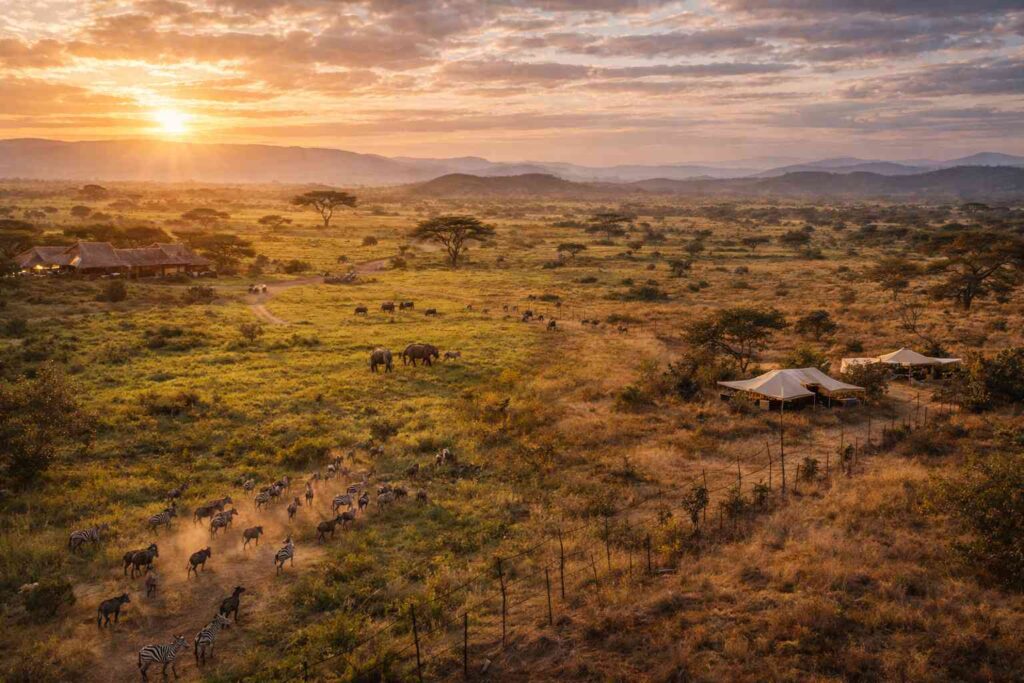
- Removing internal fencing
- Reconnecting migration routes
- Restoring seasonal movement
- Allowing ecosystems to function across political boundaries
Connectivity increases resilience to:
- Climate variability
- Drought and flood cycles
- Local population crashes
In practical terms, this means ecosystems can breathe and adapt, rather than being locked into fragile, artificial balance.
Rewilding and People: A Necessary Partnership
Rewilding in Africa cannot succeed without people.
Unlike the fortress-style conservation of the past, modern rewilding recognizes that:
- Humans are part of the ecosystem
- Local communities shape landscapes daily
- Long-term success depends on shared benefits
Many rewilding initiatives integrate:
- Sustainable livelihoods linked to restored land
- Community-led land stewardship
- Reduced conflict through healthier ecosystems
When land recovers, it often supports more water, better soil, and greater productivity — benefits felt well beyond wildlife alone.
Signs of Recovery: What Rewilded Landscapes Look Like
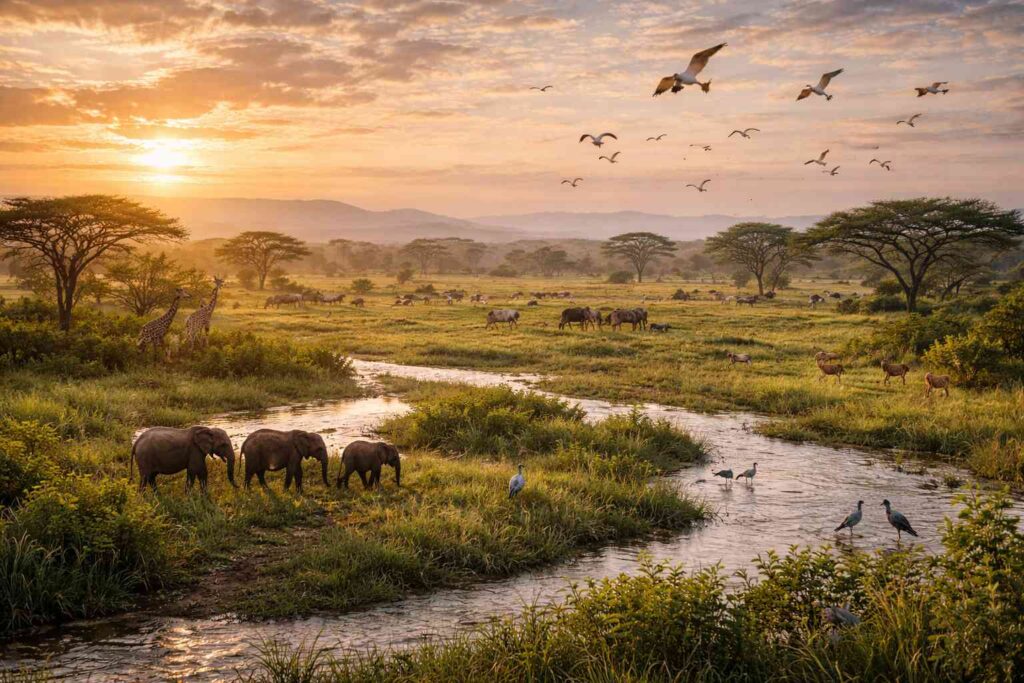
Rewilding does not always look dramatic at first. Early signs of success often include:
- Increased plant diversity
- Return of insects and birds
- Improved soil structure
- More stable water flows
Larger animals may return later, once the foundation is rebuilt. True rewilding success is measured not by a single species, but by complexity, resilience, and balance.
Rewilding vs. Traditional Conservation
| Traditional conservation | Rewilding |
|---|---|
| Static protection | Dynamic recovery |
| Human-managed balance | Self-regulating systems |
| Species-focused | Process-focused |
| Short-term intervention | Long-term resilience |
Both approaches matter — but rewilding addresses what protection alone often cannot: ecosystem function.
Why Rewilding Matters in a Changing Climate
Africa is on the front line of climate change. Rewilded ecosystems are:
- More drought-resilient
- Better at storing carbon in soils and vegetation
- More adaptable to extreme weather
- Less dependent on constant human input
In this sense, rewilding is not only about biodiversity — it is a climate adaptation strategy rooted in ecology.
What This Means for Travelers and Observers
For safari travelers and nature enthusiasts, rewilding changes how we experience landscapes:
- A recovering area may feel quieter at first
- Wildlife patterns may be less predictable
- Diversity replaces density
But over time, these places often offer deeper, more meaningful encounters — where animals behave naturally, ecosystems function freely, and nature feels less staged.
Conclusion: Africa’s Quiet Ecological Comeback
Rewilding in Africa is not loud, fast, or flashy. It is patient work, grounded in ecology, humility, and long-term thinking. It recognizes that nature does not need to be perfected — only given the space and conditions to recover.
Across the continent, landscapes once written off are proving remarkably resilient. When pressure is reduced and processes are restored, life returns — often richer and more complex than before.
Rewilding reminds us that conservation is not just about saving what remains, but about allowing nature to heal itself.
If you want to keep exploring Africa through ecology, systems, and long-term conservation thinking, continue through the blog — this is where the deeper stories live.
Frequently Asked Questions (FAQs)
Not exactly. Conservation often focuses on protection, while rewilding focuses on restoring ecological processes and self-regulation.
No. Many rewilding projects succeed by restoring habitat and reducing pressure, allowing species to return naturally.
Yes. Some of the most effective rewilding occurs in mixed landscapes where people and nature coexist.
It can be, if done without ecological understanding. Successful rewilding is science-led and adaptive.
Years to decades. Ecosystem recovery is gradual and non-linear.
No. Strategic human involvement is often needed early on, with reduced intervention over time.
Absolutely. Africa provides powerful lessons, but rewilding is a global movement.