


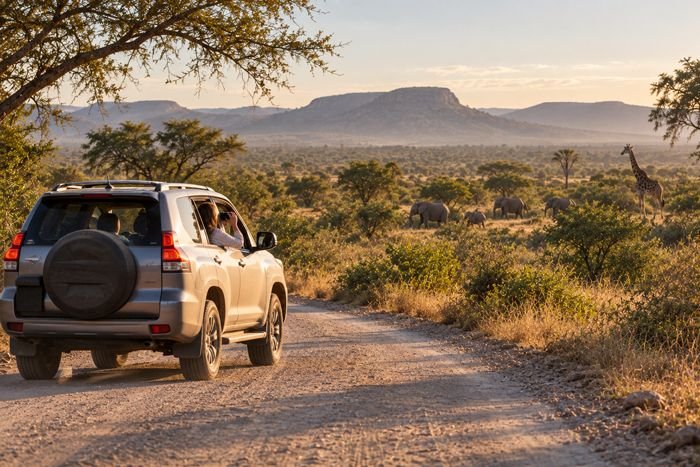
A rugged 4×4 loaded with camping equipment looks like the perfect vehicle for an African safari. It offers ground clearance, a commanding driving position, room for luggage, and the reassuring impression that almost any road is manageable.
But do you actually need one for a South African safari?
For many popular itineraries, the answer is no. Major national parks such as Kruger can be explored using an ordinary rental car, and much of South Africa has a well-developed road network connecting its major tourism regions.
A 4×4 becomes much more valuable when your itinerary includes rough gravel roads, remote destinations, challenging terrain, wilderness camping, or neighboring countries where road conditions may be significantly more demanding.
The important distinction is between needing four-wheel drive and simply benefiting from a higher, more robust vehicle.
Before paying the premium for a 4×4 rental, consider where you’re actually going, what season you’re traveling in, and how much off-the-beaten-track exploration you have planned.
Do you need a 4×4 for Kruger National Park?
This is one of the most common questions among first-time self-drive visitors.
For standard tourist routes in Kruger, four-wheel drive is generally unnecessary.
The park has an extensive network of paved and maintained gravel roads that ordinary passenger vehicles can use under normal conditions.
A compact car can therefore deliver a perfectly successful Kruger safari.
You’ll be driving slowly for wildlife viewing anyway, so the additional off-road performance of a 4×4 provides little advantage on standard routes.
What can make a difference is height.
Why vehicle height matters on safari
A higher driving position can improve visibility over roadside grass and low vegetation.
This is one reason SUVs and crossovers are popular safari rentals even when four-wheel drive isn’t required.
Imagine a lion lying in grass beside the road.
From a low hatchback, vegetation may block much of your view. From a taller SUV, you may have a clearer angle.
The same applies when looking across waterholes or scanning over other roadside vegetation.
This doesn’t mean you need the largest 4×4 available.
A comfortable crossover or two-wheel-drive SUV can provide much of the visibility advantage without the additional cost and fuel consumption of a fully equipped off-road vehicle.
When renting a 4×4 starts to make sense
The decision changes when you move beyond South Africa’s mainstream tourism routes.
A 4×4 becomes more useful when an itinerary includes:
- Remote gravel roads
- Deep sand
- Rocky tracks
- Wilderness campsites
- Mountainous terrain
- Extended overland travel
- Poorly maintained access roads
- Cross-border routes
Ground clearance can be just as important as the drivetrain.
Even when four-wheel drive isn’t engaged, a robust vehicle with appropriate tires and greater clearance can handle uneven surfaces more confidently than a small city car.
Remote South Africa is different from Kruger
South Africa is a large country, and road conditions vary considerably.
Driving between Cape Town and the Winelands is completely different from exploring remote parts of the Northern Cape.
Likewise, a self-drive through Kruger’s primary tourist network requires a different vehicle strategy from an expedition into isolated wilderness regions.
Destinations such as the Kalahari and more remote interior areas deserve closer attention to road conditions, accommodation access, and seasonal requirements.
Before booking, ask each lodge or camp about the final access road.
The last 20 kilometers of a journey can determine your vehicle requirements more than the previous 500.
A 4×4 can be useful for the Kalahari
Travelers heading toward South Africa’s more arid northwestern landscapes have stronger reasons to consider a capable vehicle.
Sand, corrugations, long distances, and isolated roads can create different challenges from mainstream safari routes.
Certain routes or wilderness areas may have specific vehicle requirements.
Don’t assume that owning or renting a 4×4 automatically makes every track safe.
Remote driving requires judgment, appropriate tire pressures where relevant, recovery knowledge, adequate water, and awareness of local conditions.
Always follow current park and route regulations.
What about rainy conditions?
Rain can change an otherwise straightforward road very quickly.
Unpaved roads may become muddy, slippery, or damaged, while water can collect in low sections.
A 4×4 can provide additional traction under some conditions, but it isn’t a license to drive through flooded or unsafe terrain.
One of the most dangerous mistakes inexperienced drivers make is assuming a large vehicle can overcome any obstacle.
If you cannot assess the depth, surface, or current of water safely, don’t drive through it.
Local advice is far more valuable than confidence.
4×4 vs SUV: understand the difference
Rental terminology can be confusing.
Not every SUV is a true four-wheel-drive vehicle.
Many modern SUVs and crossovers are two-wheel drive, while others use all-wheel-drive systems designed primarily for additional traction rather than serious off-road travel.
For an ordinary Kruger safari, this may be completely fine.
If your itinerary genuinely requires four-wheel drive, confirm the exact vehicle specification with the rental company rather than relying on the word “SUV.”
Ask whether the booked category includes true 4×4 capability and whether the rental contract permits driving on your intended roads.
The comfort advantage
Even when you don’t need four-wheel drive, larger vehicles can make long safari days more comfortable.
A higher vehicle may offer:
- More luggage space
- Better visibility
- Easier entry and exit
- More rear-seat room
- Greater comfort on gravel
- Space for photography equipment
This becomes particularly relevant for families or groups of four adults.
A tiny rental car may be economical, but after six hours of game viewing with bags and camera equipment, the savings can feel less important.
Choose the vehicle based on how you’ll actually use it, not simply the daily rental rate.
The disadvantages of renting a 4×4
A 4×4 isn’t automatically the best upgrade.
The first disadvantage is cost.
Rental rates are generally higher, and large vehicles can consume significantly more fuel.
They may also be cumbersome in cities and parking garages if your itinerary combines safari with Johannesburg, Cape Town, or other urban destinations.
Luggage security deserves consideration too.
A vehicle full of visible expedition equipment can attract unwanted attention when parked in towns. Keep valuables out of sight and follow sensible local security practices regardless of vehicle type.
Does a 4×4 allow you to drive off-road on safari?
Usually not.
This is an important misconception.
Renting a capable off-road vehicle doesn’t give you permission to leave designated tourist roads in national parks.
In Kruger, self-drive visitors must remain on roads and follow park regulations.
Private reserves may conduct controlled off-road driving during guided safaris, but that is managed by trained guides under the reserve’s own rules.
Never follow an animal off-road simply because your rental vehicle is capable of doing so.
A 4×4 changes what the vehicle can physically do—not what visitors are legally permitted to do.
4×4 campers for longer adventures
A different category is the fully equipped 4×4 camper.
These vehicles may include rooftop tents, refrigerators, cooking equipment, water storage, and camping gear.
For an extended overland trip, this setup can be excellent.
It provides considerable independence and works particularly well for travelers combining South Africa with more remote parts of neighboring countries.
However, there is a trade-off.
Setting up camp every evening, preparing food, managing supplies, and packing everything away each morning requires time and effort.
If your idea of safari involves comfortable lodges and restaurant meals, paying for a fully equipped camper makes little sense.
Check the rental contract carefully
Before taking any rental vehicle onto gravel or remote roads, read the contract.
Insurance and damage policies can vary significantly.
Pay particular attention to:
- Tire damage
- Windscreen damage
- Undercarriage damage
- Water damage
- Single-vehicle incidents
- Gravel-road restrictions
- Cross-border travel
- Unauthorized roads
If you’re traveling outside South Africa, additional documentation and rental-company authorization may be required.
Never assume that because the vehicle can cross a border, the rental agreement allows it.
Tires matter more than many travelers realize
On remote self-drive itineraries, tires can become one of the most important components of the vehicle.
Long gravel roads increase the possibility of punctures and tire damage.
Before leaving the rental depot, check the spare tire and confirm that the necessary wheel-changing equipment is present.
On especially remote itineraries, travelers should also know how to change a tire safely rather than discovering the process for the first time beside an empty gravel road.
A premium 4×4 with inappropriate or damaged tires isn’t necessarily more useful than a simpler vehicle in good condition.
Fuel planning in remote areas
South Africa has extensive fuel infrastructure along major routes, but remote safari itineraries require more planning.
Don’t wait until the warning light appears before looking for a fuel station.
Distances can be substantial, and smaller stations may not always operate according to the schedule you expected.
Large 4x4s also tend to consume more fuel than compact cars.
Calculate your realistic range and refuel conservatively when heading into isolated areas.
Is a 4×4 worth it for families?
Sometimes.
Families can benefit from additional space, luggage capacity, and the higher seating position.
Children may find wildlife easier to see, particularly from rear seats.
But don’t choose an enormous expedition vehicle solely because it looks appropriate for safari.
A comfortable SUV may provide all the space and visibility your family needs for Kruger and other mainstream destinations.
The best family vehicle is usually the smallest one that comfortably accommodates everyone, their luggage, and any bulky equipment.
Which vehicle should you rent?
For a typical Kruger self-drive on established roads, a normal rental car can be sufficient.
For better visibility and comfort, consider a crossover or SUV.
Choose a genuine 4×4 when your itinerary includes roads or destinations where additional traction, clearance, and durability provide a meaningful advantage—or where four-wheel drive is specifically required.
Choose an equipped 4×4 camper when the vehicle is part of the adventure itself and you plan to use remote campsites extensively.
The key is matching the vehicle to the route rather than the safari image in your head.
Conclusion
Renting a 4×4 for a South African safari can be worthwhile, but it isn’t automatically necessary.
If you’re exploring Kruger National Park, staying in established accommodation, and driving mainstream tourism routes, an ordinary car or comfortable SUV will usually provide everything you need. A higher seating position may improve wildlife viewing, but four-wheel drive itself offers limited benefit when you’re staying on maintained roads.
A true 4×4 becomes more valuable as the itinerary becomes more adventurous: remote gravel roads, sandy terrain, wilderness camping, and extended overland travel all strengthen the case.
Before booking, examine your route carefully, confirm lodge access conditions, read the rental contract, and understand what your vehicle is—and isn’t—allowed to do.
Spend the money on capability when you genuinely need it. Otherwise, a simpler rental may leave more of your safari budget available for the experiences that matter.
For more South Africa self-drive advice, Kruger planning guides, and practical tips for building an independent safari itinerary, continue exploring the WhySafari blog.
Frequently asked questions
Choose whichever transmission you’re most comfortable driving. Safari requires constant attention to wildlife and road conditions, so familiarity is more valuable than saving a small amount on the rental rate.
Yes. Vehicles drive on the left-hand side of the road. Travelers accustomed to right-hand traffic should allow time to adjust, particularly at intersections and roundabouts.
Many rental companies offer one-way rentals, although additional fees may apply. Confirm availability and charges before building your itinerary around this option.
For mainstream routes, usually not. For extended remote travel, an additional spare may be worth considering depending on the route and rental setup.
Cards are widely useful, but having some backup payment options is sensible when traveling through remote areas. Don’t rely on one card or payment method exclusively.
Some rental companies permit cross-border travel with prior authorization and appropriate documentation. Never cross an international border without confirming the rental company’s requirements first.
Requirements depend on your license and rental provider. Confirm current South African regulations and the rental company’s conditions before departure.
Photograph existing damage and inspect the tires, spare wheel, windscreen, lights, tools, and supplied equipment. Make sure any problems are documented before leaving the depot.


