Some safari destinations impress through sheer numbers of animals. Others offer luxurious lodges, predictable game-drive circuits, or famous annual wildlife events. Mana Pools National Park offers something increasingly difficult to find: a genuine sense of wilderness.
Set along the Zambezi River in northern Zimbabwe, opposite Zambia’s Lower Zambezi region, Mana Pools is famous for its floodplains, enormous trees, elephants, wild dogs, lions, and immersive safari experiences on foot and by canoe.
Its character is different from busier safari destinations.
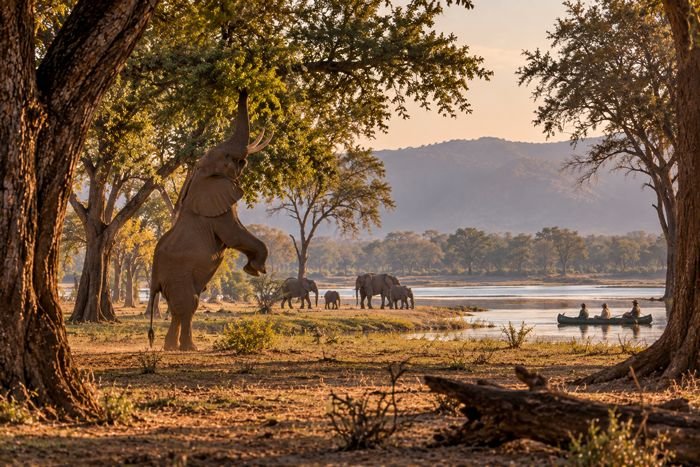
There are fewer vehicles, limited infrastructure, and a strong emphasis on experiencing wildlife at ground level. You may watch an elephant stretch onto its hind legs to reach seed pods, follow tracks with an experienced walking guide, or paddle quietly past hippos while the Zambezi escarpment rises in the distance.
Mana Pools isn’t necessarily the easiest first safari in Africa. But for travelers seeking adventure, photography, and an unusually intimate connection with the bush, it can be one of the continent’s most rewarding destinations.
Why Mana Pools feels so wild
Mana Pools lies within a vast conservation landscape associated with the Zambezi Valley.
The park’s name refers to seasonal pools associated with the river’s floodplain. Water, woodland, open areas, and the Zambezi itself combine to create an extraordinarily productive wildlife environment.
Unlike destinations dominated by extensive networks of busy safari roads, Mana Pools retains a low-density character.
That changes the atmosphere immediately.
Instead of moving constantly between reported sightings, visitors can spend significant periods observing one area, tracking animals, or exploring with guides.
The result feels less like visiting a wildlife attraction and more like temporarily entering an ecosystem that continues largely on its own terms.
The Zambezi River shapes everything
The Zambezi isn’t simply a beautiful boundary along the park.
It is the ecological backbone of Mana Pools.
As dry conditions intensify, wildlife becomes increasingly dependent on the river, floodplain, and remaining water sources.
Elephants, buffalo, antelope, and other herbivores move through these productive areas, while predators follow opportunities created by their concentration.
The river also introduces an entirely different safari environment.
Hippos and crocodiles inhabit the water, elephants may appear along the banks, and abundant birdlife occupies the channels and surrounding woodland.
Across the river, the Zambian escarpment creates one of southern Africa’s most memorable safari backdrops.
Mana Pools is famous for its elephants
Elephants are among the park’s defining animals.
What makes them particularly memorable isn’t simply their presence, but how they use the landscape.
Mana Pools has become famous among photographers for elephants feeding beneath large trees, including individuals that sometimes rise onto their hind legs to reach higher branches or seed pods.
It is extraordinary behavior to witness.
However, travelers should never approach elephants attempting to provoke or recreate a famous photograph.
Wildlife behavior must remain natural.
A knowledgeable guide can help position visitors responsibly and interpret subtle signs of elephant mood and movement.
Watching a relaxed elephant feeding quietly beneath the trees is already more than enough.
Walking safaris change the experience
Mana Pools has an especially strong reputation for walking safaris.
On foot, safari operates at a completely different scale.
You begin noticing tracks, dung, plants, insects, alarm calls, wind direction, and the subtle movements that disappear when you’re inside a vehicle.
Even familiar animals feel different.
Seeing an elephant from a safari vehicle can be relaxing. Observing one on foot with a highly experienced professional guide requires far greater awareness.
Walking isn’t about getting as close as possible.
The goal is understanding how to move through wildlife habitat safely and respectfully.
Guides assess animal behavior, terrain, wind, escape routes, and countless other factors visitors may not recognize.
Always follow instructions immediately and never attempt independent approaches to dangerous wildlife.
Canoe safaris offer another perspective
The Zambezi makes Mana Pools one of Africa’s classic destinations for canoe-based wildlife experiences.
From the water, the landscape unfolds slowly.
Elephants may appear on the riverbank. Waterbirds move between channels. Hippos surface at a distance, and crocodiles may rest along exposed banks.
The experience can be wonderfully peaceful, but this is still wild Africa.
Hippos in particular require considerable respect, and canoe safaris should be conducted with qualified operators and experienced guides who understand the river.
For adventurous travelers, combining game drives, walking, and canoeing creates a safari with remarkable variety.
Predators add to Mana Pools’ reputation
Mana Pools isn’t only elephant country.
Lions inhabit the ecosystem and can produce exceptional sightings, particularly as wildlife becomes concentrated during the dry months.
The park is also renowned for African wild dogs.
These highly social predators are among Africa’s most exciting animals to observe. Their hunts, pack interactions, and constant movement can create completely unpredictable encounters.
Spotted hyenas and leopards are also part of the wider predator community, although sightings vary.
As anywhere in Africa, no particular predator encounter should be treated as guaranteed.
Mana Pools rewards time and patience.
Buffalo and other herbivores
Large buffalo herds can become an important part of the dry-season landscape.
Their presence also influences predator activity, particularly lions.
Beyond buffalo and elephants, visitors can encounter species such as impala, kudu, waterbuck, zebra, and other herbivores adapted to the Zambezi Valley environment.
The interaction between these animals matters more than simply recording individual species.
Watch how antelope react when predators are nearby. Notice where animals choose to drink. Observe how elephants influence other species around water or feeding sites.
The best Mana Pools safaris are about relationships within the ecosystem.
Birding deserves serious attention
The combination of river, floodplain, woodland, pools, and dry habitats makes Mana Pools highly rewarding for birdwatchers.
Kingfishers, bee-eaters, raptors, storks, herons, and many other species add constant activity to the landscape.
The river is particularly productive.
Even travelers who arrive with little interest in birding often discover that birds become an important part of slower activities such as canoeing and walking.
Bring binoculars.
Mana Pools encourages careful observation, and some of the day’s best sightings may have wings rather than four legs.
Why photographers love Mana Pools
Few safari landscapes are as visually recognizable as Mana Pools.
Large trees create natural frames around wildlife, while filtered light can produce an almost theatrical atmosphere.
Dust suspended in early or late sunlight can add texture, and the Zambezi escarpment provides depth behind animals on the floodplain.
Elephants are obvious photographic subjects, but the real strength is environmental wildlife photography.
Instead of filling every frame with an animal, leave room for the landscape.
A small elephant beneath an enormous tree can communicate more about Mana Pools than a tightly cropped portrait.
Walking also changes photographic possibilities, although safety and guide instructions must always take priority over positioning for an image.
When is the best time to visit Mana Pools?
The Dry Season, broadly associated with the middle and later part of the year, is the classic period for a Mana Pools safari.
As inland water becomes scarce, animals increasingly concentrate around the Zambezi and remaining pools.
Vegetation thins, wildlife can become easier to locate, and conditions are generally more favorable for many traditional safari activities.
The later dry months can produce particularly dramatic concentrations.
They can also become very hot.
Travelers should prepare for high daytime temperatures and substantial dust.
What happens during the rains?
The rainy season transforms the Zambezi Valley.
Vegetation becomes greener, water becomes more widely available, and animals can disperse.
The landscape may be beautiful, but logistics become more complicated.
Some camps operate seasonally, and road access can become difficult or unavailable depending on conditions.
This means Mana Pools doesn’t function like a straightforward year-round safari destination where travelers can simply choose any month and expect identical access.
Always confirm current camp opening periods, road conditions, transfers, and available activities for your specific travel dates.
Accommodation ranges from adventurous to luxurious
Mana Pools offers different levels of safari accommodation, from relatively simple wilderness experiences to sophisticated tented camps.
The best choice depends on how much comfort you want between activities.
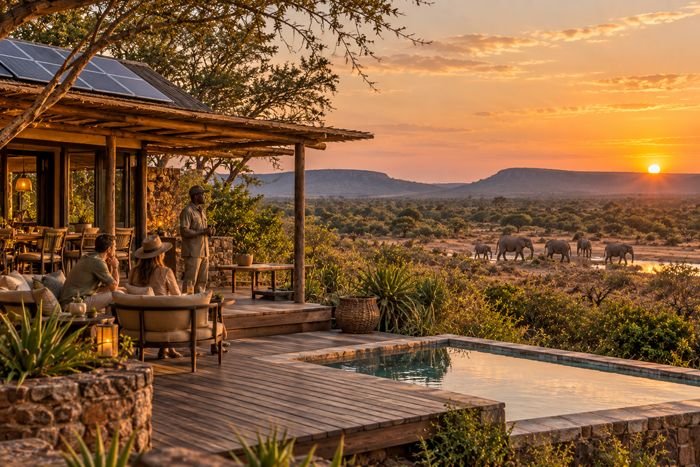
Luxury camps can provide excellent guiding, comfortable tents, quality meals, and beautiful locations without removing the sense of being deep in the bush.
More adventurous options place greater emphasis on simplicity and immersion.
When comparing camps, pay attention to more than the room.
Ask about guiding quality, walking opportunities, canoeing, camp location, transfers, and how many guests typically share a safari vehicle.
In Mana Pools, the activities and guide can matter considerably more than the thread count.
Getting there is part of the adventure
Mana Pools is remote, and that remoteness is central to its appeal.
Depending on the itinerary and season, travelers may reach the area using scheduled or charter flights followed by camp transfers. Road access is possible in appropriate circumstances but requires significantly more planning.
Don’t underestimate transfer logistics when combining Mana Pools with other Zimbabwean destinations.
Victoria Falls, Hwange, and Mana Pools can form an exceptional safari itinerary, but distances are substantial.
Flying between major safari regions can preserve valuable time, especially on shorter trips.
Is Mana Pools suitable for first-time safari travelers?
It can be, but it suits a particular kind of first-time visitor.
If you want extensive lodge facilities, easy transfers, predictable roads, and game drives as the main activity, another destination may provide a gentler introduction.
If you’re comfortable with remoteness and excited by walking, canoeing, wildlife photography, and wilderness, Mana Pools could be unforgettable even on a first safari.
Families should investigate age restrictions carefully.
Walking and canoe activities may have minimum-age requirements, and individual camps establish their own policies.
How many nights should you stay?
Three nights provides an introduction, but four or five nights allows Mana Pools to reveal itself more naturally.
Longer stays are especially worthwhile if you want to combine game drives with walking and canoeing.
Wildlife doesn’t perform according to a schedule.
One morning may be surprisingly quiet. The next could bring wild dogs, elephants, lions, and an extraordinary hour beside the river.
Giving yourself time removes the pressure to chase sightings and fits the character of the destination much better.
Mana Pools rewards travelers who slow down
Perhaps the biggest mistake visitors can make is treating Mana Pools like a Big Five checklist.
Its appeal is broader.
The sound of hippos from the river, elephant tracks crossing camp, the silence of a floodplain at sunrise, a wild dog pack disappearing into woodland, and the concentration required while walking through elephant country all become part of the experience.
The destination rewards participation rather than consumption.
You aren’t simply watching wilderness through a vehicle window.
You’re listening to it, walking through it, and sometimes paddling quietly along its edge.
Conclusion
Mana Pools National Park earns its reputation as one of Zimbabwe’s wildest safari destinations not because it lacks comfort, but because wilderness still dictates the experience.
The Zambezi River shapes wildlife movements. Elephants wander beneath enormous trees. Lions and wild dogs patrol the floodplain. Canoes provide access to a world of hippos, crocodiles, birds, and riverbank wildlife, while walking safaris force you to notice details that disappear from a vehicle.
It is remote, seasonal, and occasionally demanding.
Those qualities are precisely what make it special.
Come with enough time, choose experienced guides, respect the rules of walking and river safaris, and resist the temptation to measure the trip by how many famous animals you photograph.
For more guides to Zimbabwe’s national parks, walking safaris, remote camps, and Africa’s greatest wilderness destinations, continue exploring the WhySafari blog.
Frequently asked questions
Not necessarily, but you should be comfortable walking outdoors in potentially hot conditions. Ask your camp about typical distances and difficulty, as walking experiences vary.
Comfortable closed walking shoes with good grip are usually more practical than heavy hiking boots for most lodge-based activities. Neutral-colored clothing and lightweight layers are also useful.
Connectivity can be limited and varies by camp. Some accommodation may provide Wi-Fi or communications in designated areas, but travelers should expect a more disconnected experience.
Having an appropriate method for gratuities can be useful in remote safari camps. Ask your operator or camp about current tipping practices and accepted currencies before traveling.
Yes. The combination works extremely well because the parks provide contrasting habitats and safari experiences. Regional flights are often the most time-efficient connection.
Yes, particularly at camps where guests join shared activities and communal meals. Solo supplements and policies vary, so compare several properties before booking.
A versatile telephoto zoom is useful for wildlife, while a wider lens can capture elephants beneath trees and the scale of the floodplain. Bring dust protection and sufficient batteries and memory cards.
Mana Pools lies in a malaria-risk region. Travelers should seek current advice from a qualified medical professional or travel-health clinic well before departure.