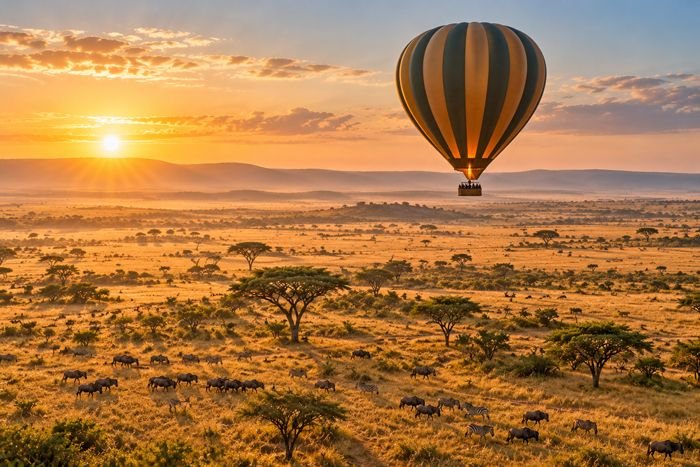
Imagine floating silently above the Serengeti as the first sunlight spreads across the African plains. Below you, wildebeest move through the grasslands, giraffes wander between acacia trees, and the vast landscape stretches toward the horizon. It’s a perspective few safari travelers ever experience.
A hot air balloon safari in the Serengeti is often described as one of Tanzania’s most unforgettable activities. But with prices around $600 per person, it’s also one of the most expensive optional experiences you can add to your itinerary.
So, is a Serengeti hot air balloon safari worth the cost?
For travelers who appreciate extraordinary landscapes, unique photography opportunities, and once-in-a-lifetime experiences, the answer is often yes. However, if your priority is seeing as many animals as possible, a traditional game drive may offer better value.
This guide explains what to expect during a Serengeti balloon safari, how much it costs, the best time to fly, and whether the experience deserves a place in your Tanzania safari budget.
What is a Serengeti hot air balloon safari?
A Serengeti hot air balloon safari is an early morning flight over the national park, allowing visitors to observe its landscapes and wildlife from above.
Unlike a conventional safari vehicle, which follows designated roads, a balloon drifts with the wind, offering uninterrupted views of the wilderness.
Flights typically begin around sunrise, when temperatures are cooler and the rising sun creates beautiful lighting across the grasslands.
Most experiences last approximately 50 to 70 minutes in the air, although the entire excursion takes several hours when transfers, preparation, and breakfast are included.
Depending on your location and the season, you might float above open savannas, woodland, river valleys, or areas where migrating wildebeest gather.
The main attraction isn’t simply spotting wildlife. It’s experiencing the enormous scale of the Serengeti from a perspective that is impossible to appreciate from the ground.
How much does a Serengeti balloon safari cost?
A Serengeti balloon safari is a premium activity, and pricing is an important consideration for most travelers.
PUBLISHED REFERENCE PRICE
US$599
per person
Published by Serengeti.com. This is a reference price, not a verified live quote; confirm your rate and inclusions before booking.
At this rate, two travelers would spend approximately $1,198 on the experience.
The price commonly includes transport from a nearby lodge or camp to the launch site, the balloon flight, and a bush breakfast after landing.
Some operators also include a celebratory sparkling-wine toast and flight certificate.
The cost reflects the logistical challenges of operating balloons in a remote national park. Specialized equipment, trained pilots, ground crews, fuel, transport vehicles, maintenance, and park-related fees all contribute to the final price.
Before booking, confirm whether the quoted amount includes every applicable charge, particularly park admission and any transport outside the standard pickup area.
What to expect during a Serengeti balloon safari
Understanding the schedule helps you decide whether the experience matches your expectations.
Before sunrise: An early start
Your day usually begins with a pickup between approximately 4:00 and 5:30 AM, depending on your accommodation and launch site.
You’ll travel through the park in darkness before arriving at the balloon launch area.
After a safety briefing, you’ll watch the crew prepare and inflate the enormous balloon.
As sunrise approaches, passengers enter the basket and prepare for takeoff.
Sunrise: Floating above the plains
The balloon gradually rises as the landscape begins to glow in the morning light.
Your pilot adjusts altitude to take advantage of different wind currents, sometimes flying higher for sweeping panoramic views and sometimes lower to observe details in the landscape.
From above, you may see elephants walking between trees, antelope moving through the grass, or wildebeest gathering in impressive herds.
However, the balloon cannot follow wildlife in the same way a safari vehicle can.
Its direction depends primarily on the wind, making every flight different.
After landing: A bush breakfast
Following the flight, the ground crew meets the balloon at its landing location.
Many excursions continue with a traditional bush breakfast served outdoors in the wilderness.
Depending on the operator, breakfast may include freshly prepared dishes, coffee, tea, and sparkling wine.
The experience usually concludes with a transfer back to your safari guide or accommodation, often during the morning.
What animals can you see from a hot air balloon?
The Serengeti is home to an extraordinary variety of wildlife, but it’s important to keep expectations realistic.
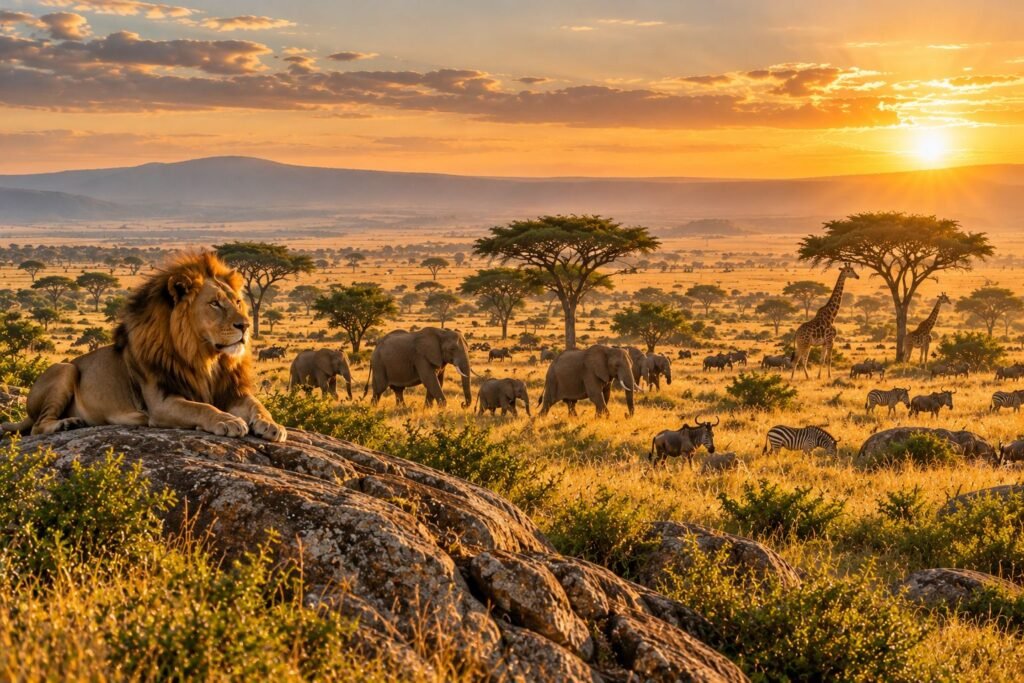
Depending on your flight route, you may spot wildebeest, zebras, giraffes, elephants, buffaloes, antelopes, and occasionally predators.
Large herds are particularly impressive from above because their patterns and movements become easier to appreciate.
However, animals can appear relatively small from a balloon, especially when flying at higher altitudes.
Even if lions or leopards are present nearby, you may struggle to identify them without binoculars or a suitable camera lens.
For close-up wildlife encounters, traditional game drives remain the better option.
A balloon safari is most rewarding when viewed as a landscape experience with the possibility of wildlife sightings rather than a guaranteed aerial Big Five safari.
Best time for a hot air balloon safari in the Serengeti
Balloon safaris operate in selected areas of the Serengeti throughout the year, with additional seasonal launch locations following wildlife movements.
| Serengeti region | Typical operating period | Main attraction |
|---|---|---|
| Central Serengeti, Seronera | Year-round | Open plains and resident wildlife |
| Southern Serengeti, Ndutu area | Approximately late December to mid-March | Calving-season herds |
| Western Corridor | Approximately June to October | Seasonal migration activity |
| Northern Serengeti | Approximately July to October | Migration herds and northern landscapes |
Operating periods are approximate and vary by provider, weather, and authorization.
January to March: Calving season
Flights around the southern ecosystem can offer beautiful views of wildebeest herds gathering on the short-grass plains.
The green landscapes and concentration of grazing animals can be especially attractive for photography.
June to October: Dry-season landscapes
The dry season generally brings clearer conditions and excellent visibility.
During the northern migration period, a balloon flight may reveal large groups of wildebeest and zebras moving across the landscape.
However, even during peak migration season, flights cannot guarantee that you’ll pass above a major herd or river crossing.
November and December: Green-season beauty
Central Serengeti remains a possible ballooning destination during the greener months.
Fresh vegetation and changing skies create beautiful scenery, although rainfall and wind conditions can sometimes affect departures.
Serengeti balloon safari vs game drive: Which is better?
For travelers with limited budgets, the most important question is whether a balloon flight offers more value than spending additional time on game drives.
| Experience | Balloon safari | Traditional game drive |
|---|---|---|
| Perspective | Panoramic aerial views | Wildlife at ground level |
| Wildlife photography | Best for landscapes and herds | Better for close-ups and behavior |
| Route flexibility | Limited by wind | Guide can adjust the route |
| Duration | Approximately one hour airborne | Several hours |
| Cost | Expensive optional activity | Usually part of safari package |
| Main advantage | Unique sunrise experience | More targeted wildlife searching |
A balloon flight provides an unforgettable perspective, but it doesn’t replace a game drive.
Experienced safari guides can stop near interesting sightings, observe animal tracks, and adapt routes based on wildlife activity.
Balloon pilots, by contrast, must prioritize safe flight conditions and cannot freely choose where the balloon travels.
If you can afford both, they complement each other beautifully.
Is a Serengeti hot air balloon safari worth the money?
The answer depends on your priorities.
When it’s worth the splurge
A balloon safari can be an excellent investment if you’re celebrating a honeymoon, anniversary, or special occasion.
It’s also appealing to photographers, landscape enthusiasts, and travelers who want to experience the Serengeti in a completely different way.
The combination of sunrise, silence between burner blasts, vast scenery, and an outdoor breakfast creates a memorable experience beyond wildlife sightings alone.
For travelers who may never return to Tanzania, this exclusivity can justify the additional cost.
When you might want to skip it
If you’re on a tight budget, spending approximately $600 per person on a flight may not be your best investment.
That money could contribute toward an additional safari night, a better-positioned camp, or a private guide.
Travelers primarily interested in close-up lion, leopard, or cheetah encounters may find game drives more satisfying.
Similarly, anyone uncomfortable with heights, restricted movement, or an unpredictable flight path should carefully consider whether the experience will be enjoyable.
The most important question is whether you’d still appreciate the flight if you saw very few animals.
If the answer is yes, it’s more likely to feel worthwhile.
Safety, weather, and booking considerations
Hot air ballooning depends on suitable weather conditions, particularly wind speed and visibility.
Professional operators use licensed pilots, established safety procedures, and ground support teams, but ballooning still carries inherent risks.
Flights may be delayed or canceled when conditions are unsuitable.
Before booking, ask about cancellation and refund policies, passenger age limits, weight restrictions, and any physical requirements for entering the basket or adopting the landing position.
Travelers who are pregnant, have significant mobility limitations, or have certain medical conditions should discuss eligibility with the operator and an appropriate healthcare professional.
Booking in advance is particularly important during peak migration months, when popular launch locations may have limited availability.
Practical tips for your first Serengeti balloon ride
A little preparation can make the morning much more comfortable.
- Dress in layers: Temperatures before sunrise can be surprisingly cool.
- Wear closed-toe shoes: Launch and landing areas may have uneven ground.
- Bring a secure camera: Loose equipment can become hazardous during takeoff or landing.
- Use binoculars: They can help identify distant animals when conditions allow.
- Follow the pilot’s instructions: Boarding and landing positions may differ from what you expect.
- Keep your schedule flexible: Weather-related changes are always possible.
It’s also worth choosing accommodation reasonably close to the launch location to avoid an unnecessarily long predawn transfer.
Final verdict: Should you book a Serengeti balloon safari?
A hot air balloon safari is one of the Serengeti’s most distinctive experiences, but it isn’t essential for everyone.
If your safari budget is comfortable and you love the idea of watching the African wilderness unfold beneath you at sunrise, it’s an experience worth considering.
However, if your priority is maximizing wildlife sightings or extending your time in the park, additional game drives may offer better value.
The best approach is to treat ballooning as a special addition to a well-planned safari, not as a substitute for exploring the Serengeti by vehicle.
Whether you choose to fly above the plains or discover them from the ground, the Serengeti offers extraordinary opportunities to connect with Africa’s wildlife.
For more Tanzania safari advice, destination comparisons, and planning inspiration, explore the WhySafari blog and discover the experiences that deserve a place on your African adventure.
Frequently asked questions about Serengeti hot air balloon safaris
Some operators accept children from around seven years old, although minimum ages and height requirements vary. Children must generally be tall enough to see over the basket safely. Always confirm the restrictions before booking.
Larger balloons may accommodate up to 16 passengers, while smaller baskets are available with certain operators. Passengers are distributed between compartments to maintain balance, so you may share the experience with other travelers.
Yes, most operators allow cameras, including DSLRs and mirrorless models. However, equipment must be secured, and restrictions may apply to large bags, tripods, and loose accessories. Check your operator’s rules beforehand.
Balloon flights usually feel relatively smooth because the balloon moves with the wind. Nevertheless, the experience differs between flights, and some passengers may feel uncomfortable during takeoff, altitude changes, or landing.
Private or exclusive balloon arrangements may be available through certain operators, subject to aircraft capacity and scheduling. These cost considerably more than shared flights and generally require advance arrangements.
Last-minute reservations are sometimes possible, but availability cannot be guaranteed. During the busiest months, places may sell out well in advance. Booking before your safari is generally the better option.
It can. The activity usually occupies most of the early morning, which would otherwise be a prime wildlife-viewing period. Your guide can often arrange an afternoon drive or adjust the day’s activities accordingly.
Visitors should not assume they can use drones in Serengeti National Park. Drone operations are subject to strict aviation and protected-area authorization requirements. A conventional camera is the more practical choice.