When the sun sets over Zambia’s South Luangwa National Park, the safari is far from over. In fact, many experienced travelers would argue that the most exciting part of the day is just beginning.
As darkness settles across the Luangwa Valley, the bush transforms. Daytime animals retreat, nocturnal species emerge, and predators begin to hunt under the cover of night. It’s during these hours that South Luangwa has earned its legendary reputation as one of the best places in Africa to see leopards.
Night drives are a signature experience in South Luangwa, offering a rare opportunity to witness wildlife behaviors that are almost impossible to observe during the day. From stealthy big cats to elusive civets and bush babies, every outing feels unpredictable—and that’s exactly what makes it so memorable.
Here’s what you can expect from a night drive in South Luangwa and why leopard lovers consider it one of Africa’s ultimate safari experiences.
Why South Luangwa is famous for leopard sightings
South Luangwa consistently ranks among Africa’s top destinations for observing leopards in the wild.
Several factors contribute to this remarkable reputation.
The park supports a healthy leopard population thanks to abundant prey, extensive riverine forests, mature woodland, and relatively low tourism pressure. Decades of conservation and skilled guiding have also helped create ideal conditions for ethical wildlife viewing.
Unlike many parks where leopard sightings can be occasional highlights, South Luangwa offers realistic opportunities to encounter these elusive cats on multiple drives.
While sightings are never guaranteed, the odds here are among the best on the continent.
Why leopards are more active at night
Although leopards can certainly be seen during daylight hours, they are primarily nocturnal animals.
Night offers several advantages:
- Cooler temperatures
- Better hunting conditions
- Less competition from larger predators
- Increased movement among prey species
As darkness falls, leopards become noticeably more active, patrolling territories, scent-marking, searching for prey, or dragging successful kills into trees to protect them from scavengers.
Watching these natural behaviors is one of the greatest rewards of a night safari.
What happens during a night drive?
Most night drives begin shortly before sunset.
Guests leave camp in open safari vehicles, enjoying the final daylight before darkness gradually takes over the landscape.
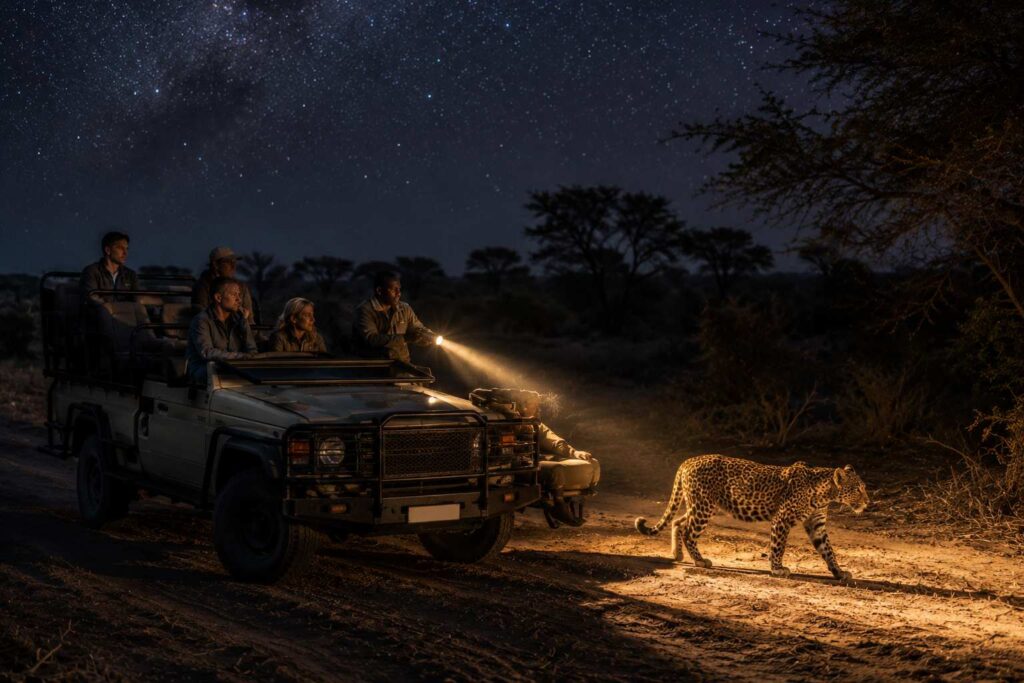
Once the sun disappears, your guide or spotter begins using a powerful handheld spotlight to scan the bush carefully.
Rather than shining directly into an animal’s eyes for extended periods, experienced guides sweep the light slowly across the landscape, looking for the distinctive reflection of eyeshine.
When wildlife is found, the spotlight is used thoughtfully and briefly to minimize disturbance while allowing guests to observe natural behavior.
Throughout the drive, guides explain animal movements, hunting strategies, vocalizations, and the unique adaptations that help nocturnal species survive.
Finding leopards after dark
Spotting a leopard at night is unlike any daytime sighting.
Sometimes the first clue is a pair of glowing eyes reflecting from dense woodland. Other times, your guide notices fresh tracks crossing the road or hears alarm calls from impalas or baboons signaling a nearby predator.
Leopards often move silently through the undergrowth before suddenly appearing in open clearings illuminated by the spotlight.
Guests may witness a leopard:
- Walking confidently along the road
- Stalking impala
- Resting beneath trees
- Climbing with remarkable agility
- Dragging prey into branches
- Marking territory
Every encounter feels intimate because the surrounding darkness naturally focuses attention on the animal itself.
It’s not just about leopards
Although leopards are the stars of many night drives, they are far from the only attraction.
South Luangwa’s nocturnal wildlife includes:
- Spotted hyenas
- Civets
- Genets
- Bush babies
- Porcupines
- Honey badgers (occasionally)
- African wild cats
- Owls
- Nightjars
- Spring hares
Many of these species are rarely seen during daylight hours, making every drive a chance to discover an entirely different side of the ecosystem.
Even familiar animals behave differently after sunset. Hippos leave rivers to graze, elephants feed quietly through woodland, and lions often become far more active.
The role of experienced guides
Night drives depend heavily on guide expertise.
Finding wildlife in darkness requires years of experience interpreting subtle clues that most visitors would never notice.
Professional guides combine:
- Animal behavior knowledge
- Tracking skills
- Bird and mammal calls
- Fresh spoor
- Wind direction
- Habitat familiarity
In many camps, guides work alongside expert spotters whose sole responsibility is scanning the bush while the driver focuses on navigating safely.
This teamwork greatly improves wildlife sightings while ensuring guest safety throughout the drive.
Photography after dark
Night photography presents unique opportunities as well as challenges.
Most visitors rely on high ISO settings and fast lenses, although professional photographers often bring specialized equipment.
Some tips include:
- Ask your guide before using flash.
- Increase your camera’s ISO sensitivity.
- Use fast shutter speeds where possible.
- Stabilize your camera against the vehicle.
- Respect wildlife by avoiding excessive photography during sensitive behaviors.
Many travelers choose simply to enjoy the experience rather than spending the entire drive behind a camera.
Safety during night drives
Night drives in South Luangwa are conducted under strict safety protocols.
Guests remain inside specially designed safari vehicles while experienced guides monitor wildlife behavior throughout the excursion.
Spotlights are used responsibly, vehicles maintain respectful distances, and guides carefully assess each situation before approaching animals.
Visitors should remain seated, avoid sudden movements, and follow guide instructions at all times.
Although you’re traveling through true wilderness, professional procedures make night drives both safe and remarkably comfortable.
When is the best time for leopard sightings?
Leopards can be seen throughout the year, but the dry season generally provides the most consistent viewing opportunities.
Between roughly June and October:
- Vegetation becomes less dense.
- Wildlife gathers around permanent water.
- Visibility improves.
- Roads are easier to navigate.
These conditions help guides locate predators more efficiently.
That said, South Luangwa enjoys excellent leopard sightings across much of the year, making it a rewarding destination regardless of season.
Is a night drive worth it?
For most visitors, absolutely.
Daytime game drives reveal one version of the African bush.
Night drives reveal another entirely.
Instead of simply adding more wildlife sightings, they offer a completely different understanding of how the ecosystem functions after sunset.
Many guests finish their safari saying the most unforgettable moment wasn’t watching elephants in daylight—it was seeing a leopard emerge silently from the darkness.
Tips before your first night drive
A few simple preparations will make the experience more enjoyable.
Bring:
- A warm jacket or fleece for cool evenings.
- Binoculars suitable for low light if available.
- A camera with good low-light performance.
- Insect repellent.
- Patience.
Remember that night drives focus on quality rather than quantity. Some evenings revolve around one unforgettable leopard encounter, while others reveal dozens of smaller nocturnal creatures.
Both experiences are equally rewarding.
Conclusion
A night drive in South Luangwa is one of Africa’s most exciting safari experiences. Renowned for exceptional leopard sightings, expert guides, and an abundance of nocturnal wildlife, the park offers a rare opportunity to witness the bush after dark, when many of its most fascinating animals become active.
Whether you’re watching a leopard patrol its territory, listening to distant hyenas calling across the valley, or spotting a tiny bush baby leaping through the trees, every drive offers a fresh perspective on one of Africa’s richest ecosystems.
For more Zambia safari guides, destination advice, and wildlife travel inspiration, continue exploring the WhySafari blog.
FAQs
Yes. Professionally guided night drives are one of the park’s signature safari activities and are offered by many lodges during the operating season.
The park supports a healthy leopard population, experienced guides, abundant prey, and excellent habitat, making sightings more frequent than in many other safari destinations.
Yes. Lions often become more active after sunset, and sightings are fairly common alongside leopards, hyenas, and other nocturnal wildlife.
Professional guides use spotlights responsibly, avoiding prolonged exposure and minimizing disturbance while allowing guests to observe wildlife safely.
It can be challenging because of low light, but modern cameras with good high-ISO performance produce excellent results. Many guests also choose simply to enjoy the experience.
Evenings can become surprisingly cool, particularly during the dry season. Bring a warm layer, comfortable clothing, and closed shoes.
No. Many national parks prohibit night drives. South Luangwa is one of the few premier safari destinations where they are an established and highly regarded activity.