


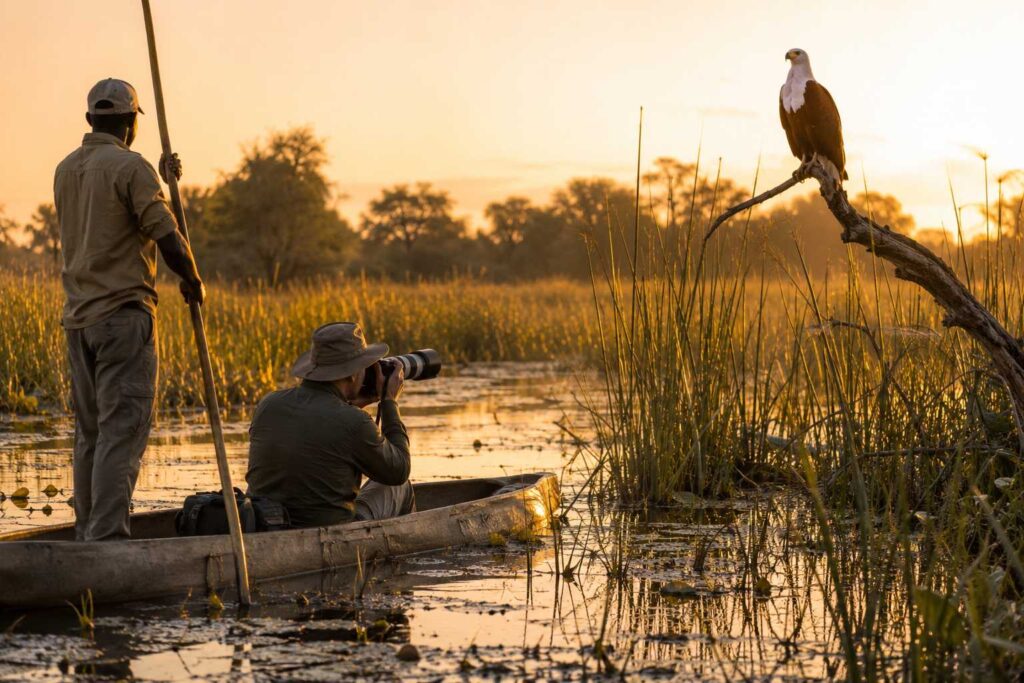
A mokoro gliding silently through the Okavango Delta or a boat safari along Botswana’s Chobe River offers some of Africa’s most unique wildlife photography opportunities. Unlike traditional game drives, you’re photographing from water level, often much closer to birds, hippos, crocodiles, elephants, and stunning reflections.
But shooting from a small, constantly moving boat presents its own challenges. Space is limited, stability is reduced, and protecting your equipment from water becomes just as important as choosing the right lens.
Fortunately, you don’t need a suitcase full of professional gear to return with incredible images. Packing thoughtfully—and understanding the conditions you’ll face—will make a much bigger difference.
This guide explains what camera equipment is worth bringing, what you can leave at home, and how to protect your gear while enjoying a mokoro or boat safari.
How photography differs on a water safari
Photography from a boat isn’t the same as shooting from a safari vehicle.
Several factors change your approach:
- Constant movement
- Lower shooting angle
- Limited storage space
- Bright reflections from the water
- Greater exposure to spray and moisture
You’ll often photograph wildlife at eye level, creating intimate and dramatic compositions that aren’t possible from a vehicle.
The trade-off is that stability becomes much more important.
Choosing the right camera body
The best camera is one you’re comfortable using quickly.
Whether you shoot with a DSLR or mirrorless camera, prioritize:
- Fast autofocus
- Good low-light performance
- Weather sealing if available
- Comfortable ergonomics
Modern APS-C and full-frame cameras both perform exceptionally well for safari photography.
If you have two camera bodies, bringing both can reduce the need to change lenses in dusty or wet environments.
The ideal telephoto lens
A medium-to-long telephoto is the most versatile choice.
For most photographers, a zoom such as:
- 100–400mm
- 150–500mm
- 200–600mm
offers enough reach for distant wildlife while remaining flexible when animals approach the boat.
Zoom lenses are especially useful because wildlife distances change quickly.
Prime lenses deliver outstanding image quality but offer less flexibility in confined spaces.
Don’t forget a shorter lens
Not every subject will be far away.
A second lens in the range of:
- 24–70mm
- 24–105mm
- 70–200mm
works well for:
- Landscapes
- River scenery
- People in the mokoro
- Sunset photography
- Environmental wildlife portraits
Some of the most memorable safari photographs include both animals and their surroundings.
Is an ultra-wide lens necessary?
Only occasionally.
An ultra-wide lens can be useful for:
- Dramatic landscapes
- Camp photography
- Starry skies
- Interior lodge images
However, most wildlife photographers will use their telephoto far more often.
If luggage space is limited, prioritize versatile zoom lenses instead.
Should you bring a tripod?
For most mokoro and boat safaris, the answer is no.
Tripods are difficult to use because:
- Boats constantly move.
- Space is extremely limited.
- They create obstacles for other passengers.
Instead, many photographers rely on:
- Good handholding technique
- Image stabilization
- Fast shutter speeds
For land-based photography at your lodge, a lightweight travel tripod can still be useful.
Bean bags and monopods
A bean bag is one of the most useful safari accessories on game drives, but it’s generally less practical on small boats or mokoros where there are few stable surfaces.
Monopods can occasionally help on larger boats but are often unnecessary.
For most water safaris, shooting handheld provides the greatest flexibility.
Protecting your equipment from water
Even calm rivers can present risks.
Protect your camera gear with:
- Waterproof dry bags
- Rain covers
- Microfiber cloths
- Lens cloths
- Padded camera inserts
A waterproof backpack or roll-top dry bag is particularly valuable during mokoro excursions where accidental splashes are always possible.
Keeping silica gel packets inside your camera bag also helps reduce moisture buildup in humid environments.
Spare batteries
Boat safaris often last several hours.
Bring:
- At least two fully charged spare batteries.
- Your charger.
- A power bank if your camera supports USB charging.
Continuous autofocus and image stabilization consume battery power more quickly than many photographers expect.
Memory cards
Rather than carrying one very large memory card, pack several medium-capacity cards.
This approach:
- Reduces the risk of data loss.
- Makes file organization easier.
- Provides backup if a card fails.
Fast cards also help cameras clear their buffers more quickly during action sequences.
Camera settings for moving boats
Because the boat is constantly moving, fast shutter speeds are essential.
As a starting point:
- Use shutter priority or manual mode.
- Aim for at least 1/1000 second for wildlife.
- Increase ISO when necessary.
- Use continuous autofocus.
- Shoot in burst mode during action.
Modern cameras handle higher ISO settings remarkably well, making sharp images more important than perfectly clean files.
Polarizing filters: Helpful or not?
A circular polarizing filter can reduce reflections on water and deepen blue skies.
However, it also reduces the amount of light reaching the sensor.
Many wildlife photographers remove the filter during early morning or late afternoon when light levels are lower.
For landscape photography in bright midday conditions, a polarizer can be very useful.
What not to bring
Space is limited, so avoid packing equipment you’re unlikely to use.
Leave behind:
- Large studio tripods.
- Heavy lighting equipment.
- Multiple duplicate lenses.
- Large hard-shell cases.
Keeping your kit compact makes moving around the boat much easier.
Beyond the camera
A few accessories can dramatically improve your experience.
Consider packing:
- Sunglasses
- Wide-brimmed hat
- Sunscreen
- Lens cleaning blower
- Microfiber towel
- Lightweight waterproof jacket
Protecting yourself is just as important as protecting your camera.
Photography tips for mokoro and boat safaris
To capture stronger images:
- Focus on eye-level compositions.
- Include reflections when possible.
- Photograph wildlife interacting with water.
- Be patient and avoid constant lens changes.
- Look behind you as well as ahead.
Some of the best photographs happen when elephants cross rivers or birds suddenly take flight.
Conclusion
A mokoro or boat safari offers one of Africa’s most rewarding photography experiences, combining unique perspectives with exceptional wildlife encounters. You don’t need an enormous collection of equipment to capture memorable images—just a versatile camera, a reliable telephoto zoom, sensible protection against water, and an understanding of how shooting from a moving boat differs from photographing on land.
Packing light, staying flexible, and focusing on the experience rather than the gear will leave you better prepared to capture everything from elephants crossing rivers to kingfishers diving for fish. Sometimes, the most unforgettable moments happen when you simply lower the camera and appreciate the quiet beauty of Africa’s waterways.
For more safari photography guides, packing advice, and African travel inspiration, continue exploring the WhySafari blog.
FAQs
A telephoto zoom in the 100–400mm or 200–600mm range offers excellent flexibility for photographing wildlife at varying distances.
Generally no. Tripods are difficult to use on moving boats. Handheld photography with image stabilization is usually the better option.
Use a waterproof dry bag, rain cover, and microfiber cloths, and avoid leaving equipment exposed when not in use.
Both work well. Modern mirrorless cameras often offer faster autofocus and better subject tracking, but either system can produce outstanding safari images.
It’s possible but not ideal. Limited space and exposure to moisture make it better to minimize lens changes whenever possible.
No. Most photographers use standard cameras protected by waterproof bags and weather-resistant covers.
Absolutely. Boat safaris provide excellent opportunities to photograph kingfishers, fish eagles, herons, bee-eaters, and many other species from low, eye-level angles.


