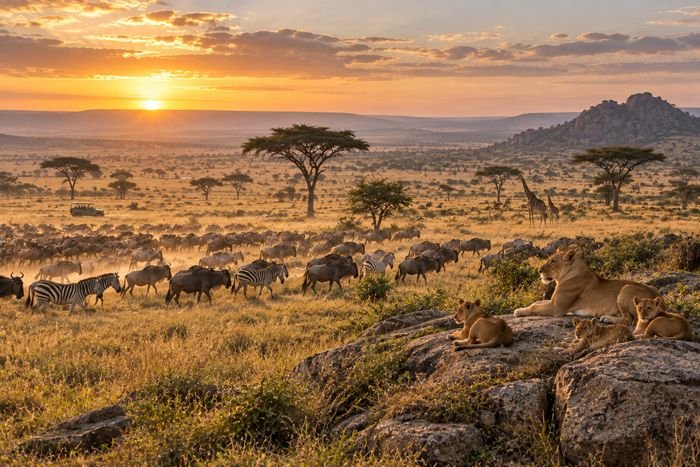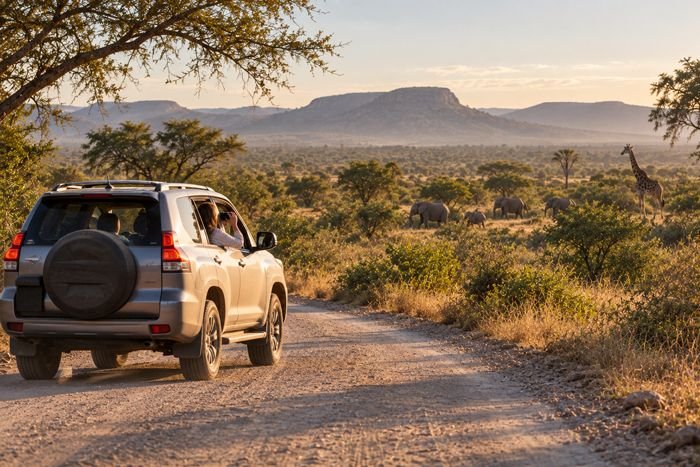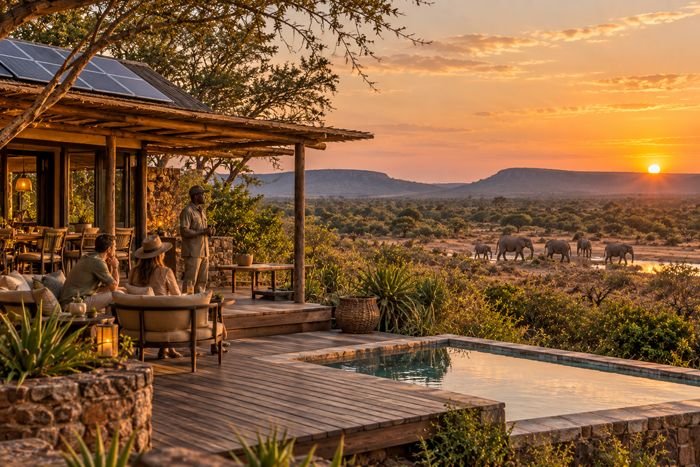
South Africa’s best eco-lodges are changing the idea that a sustainable safari means sacrificing comfort.
Across the country, lodges and community-based tourism projects are experimenting with renewable energy, lower-impact construction, water conservation, local employment, habitat restoration, responsible sourcing, and conservation partnerships. Some operate luxurious suites overlooking Big Five landscapes; others offer simpler accommodation where community participation is central to the experience.
But the popularity of sustainable travel has also created a problem: almost any property can describe itself as “eco-friendly.”
A few recycling bins and reusable water bottles don’t automatically make a lodge sustainable.
For travelers, the more useful question is what happens behind the scenes. Where does the energy come from? How is water managed? Who owns or benefits from the tourism operation? Does revenue contribute to protecting habitat? Are local people represented in permanent jobs and decision-making?
Understanding those questions makes it easier to identify eco-lodges in South Africa that are genuinely moving tourism in a better direction.
What makes an eco-lodge genuinely sustainable?
There is no single feature that transforms conventional accommodation into an eco-lodge.
Sustainability works across several interconnected areas.
A lodge can minimize energy consumption while still offering little benefit to its neighboring community. Another may generate valuable local employment but struggle with water use. A remote safari property might depend on vehicles and complex supply chains while simultaneously protecting thousands of hectares of wildlife habitat.
Rather than searching for perfection, look for evidence of a broader strategy.
The strongest properties generally address environmental impact, conservation, community benefits, and the long-term economics of protecting the destination.
Renewable energy is becoming increasingly important
Safari lodges can consume substantial amounts of electricity.
Guest rooms, kitchens, refrigeration, water pumps, laundry facilities, lighting, and communications all require power—often in remote locations.
Solar energy is therefore one of the most visible changes across environmentally conscious safari properties.
Solar arrays combined with battery storage can reduce dependence on generators and conventional electricity. Some properties also design rooms to maximize natural ventilation and light, reducing the need for intensive cooling.
But travelers should look beyond the presence of solar panels.
A stronger sustainability strategy also considers overall consumption. Energy efficiency, thoughtful architecture, appropriate lighting, and operational discipline matter alongside the source of electricity.
Water conservation matters enormously
In many South African environments, water is a limited resource.
Luxury tourism can place additional pressure on that resource through swimming pools, gardens, laundry, showers, kitchens, and guest facilities.
Responsible lodges address the issue in multiple ways.
Low-flow fixtures, careful linen policies, wastewater treatment, water monitoring, rainwater capture where appropriate, and indigenous landscaping can all reduce consumption.
Guests have a role too.
A lodge can install sophisticated water-saving systems, but long showers and unnecessary daily laundry still increase demand.
Sustainable tourism works best when good infrastructure and responsible traveler behavior reinforce each other.
Greater Kruger is an important testing ground
The Greater Kruger region contains some of South Africa’s most celebrated safari lodges, but operating in a wildlife-rich landscape comes with responsibility.
Properties here increasingly incorporate sustainability into both construction and daily operations.
Renewable energy, reduced single-use plastics, water treatment, locally sourced products, environmental education, and conservation funding can all form part of the model.
More importantly, safari tourism helps give wildlife habitat economic value.
When functioning responsibly, lodge revenue supports employment, reserve management, ecological monitoring, and conservation activities.
That connection between tourism and habitat protection is one of the most important aspects of sustainable safari travel.
Conservation should go beyond the lodge grounds
An environmentally efficient building is useful, but safari sustainability has to consider the surrounding ecosystem.
Wildlife doesn’t recognize property boundaries.
Elephants, predators, antelope, and other animals depend on connected landscapes large enough to support natural movement.
Responsible safari operations can contribute to conservation through reserve fees, habitat management, research partnerships, ecological monitoring, and support for protected landscapes.
This is why evaluating an eco-lodge requires looking beyond whether toiletries come in refillable bottles.
Ask what the property contributes to the land around it.
Community involvement is just as important
Sustainability isn’t only about wildlife.
Tourism exists within human landscapes, and local communities need to receive meaningful benefits if conservation-based tourism is expected to endure.
Employment is one obvious contribution.
Lodges require guides, hospitality staff, chefs, maintenance teams, drivers, managers, and many other professionals.
The strongest models go further through training, career development, local procurement, community partnerships, and, in some cases, community ownership or participation in tourism enterprises.
These distinctions matter.
A lodge located near a community is not automatically community-based. Travelers should look for clear explanations of how benefits are distributed and who participates in decision-making.
Bulungula shows a different side of sustainable tourism
Not every leading sustainability example in South Africa is a luxury safari lodge.
The Bulungula Lodge experience on the Wild Coast illustrates a community-centered approach to responsible tourism.
Its sustainability model places strong emphasis on local participation, low-impact living, and the relationship between tourism and the surrounding community.
This provides an important contrast to high-end safari conservation.
Sustainable tourism doesn’t need to mean infinity pools, designer architecture, and expensive private game drives.
Sometimes its most important achievement is creating a tourism economy in which local people have a direct stake.
KwaZulu-Natal adds another conservation model
KwaZulu-Natal offers another perspective on eco-tourism, combining wildlife conservation with landscapes shaped by long histories of local communities and protected areas.
Projects associated with wilderness and reserve restoration demonstrate how tourism can contribute to the economic case for conserving or rehabilitating land.
The mFulaWozi Wilderness area, for example, represents the type of destination where luxury tourism is connected to a broader conservation landscape.
For travelers, this highlights an important principle: ask what existed before the tourism project and what has changed because of it.
Has habitat been restored? Are wildlife populations better protected? Have local employment opportunities increased?
Those outcomes reveal far more than the word “eco” in a property’s marketing materials.
Sustainable design should fit the landscape
Good eco-lodge architecture tries to work with its environment rather than dominate it.
That can mean using existing clearings instead of unnecessarily removing vegetation, limiting the physical footprint of buildings, choosing materials carefully, and designing structures around natural airflow and shade.
In safari environments, low-impact design also helps preserve the sense of wilderness.
A lodge doesn’t need to disappear completely into the bush, but thoughtful placement can reduce visual disturbance and unnecessary habitat modification.
Luxury and restraint can coexist.
In fact, some of the most memorable safari rooms are successful precisely because the landscape remains the main attraction.
Waste is another revealing indicator
Remote lodges face a difficult waste-management challenge.
Everything brought into a wilderness area eventually has to be consumed, reused, recycled, composted, or removed.
Single-use plastics are an obvious target, but food waste, packaging, glass, cleaning products, and wastewater also matter.
Some lodges reduce waste by using refillable water stations, bulk amenities, reusable containers, careful purchasing, and separation systems.
Travelers can contribute by avoiding unnecessary packaging in their luggage and bringing reusable essentials.
Again, no individual measure proves sustainability.
The important question is whether waste reduction is integrated into everyday operations.
How to recognize greenwashing
The word “eco” is easy to use.
Evidence is harder to produce.
Be cautious when a property makes broad environmental claims without explaining specific actions.
Instead of being impressed by statements such as “we care deeply about nature,” look for measurable information.
Does the lodge explain its energy system?
Does it describe water management?
Can it identify conservation projects or community partnerships?
Does it discuss local employment and procurement?
Are there credible certifications, audits, partnerships, or transparent sustainability reports?
A responsible property should be comfortable explaining both its achievements and its limitations.
Sustainability is an ongoing process, not a marketing badge.
Does luxury conflict with sustainability?
Not necessarily.
Luxury safari tourism can consume significant resources, but it can also generate substantial revenue from relatively small numbers of visitors.
In conservation areas, that high-value, lower-volume model can help finance large protected landscapes without requiring mass tourism.
The key question is where the money goes and how the property operates.
A high nightly rate means little from a sustainability perspective if benefits don’t reach conservation or neighboring communities.
Conversely, a well-managed luxury lodge can potentially fund jobs, habitat protection, ecological work, and local supply chains while keeping visitor density relatively low.
Price alone tells you very little about impact.
Questions to ask before booking an eco-lodge
Travelers don’t need to conduct an environmental audit before every safari.
A few thoughtful questions can reveal a great deal.
Ask how the lodge generates electricity and manages water. Find out whether waste is processed locally or transported elsewhere. Look at the property’s relationship with its reserve and neighboring communities.
Ask what percentage of staff comes from surrounding areas and whether there are pathways into skilled and management positions.
You can also ask how conservation fees are used.
Specific answers are encouraging.
Vague promises deserve more scrutiny.
How guests can reduce their own safari footprint
Choosing a responsible lodge is only part of sustainable travel.
Visitors influence the environmental cost of a trip through their own decisions.
Stay longer in fewer destinations rather than constantly moving between lodges. Avoid unnecessary linen changes. Carry a reusable bottle where safe drinking-water systems allow it. Respect wildlife-viewing rules and never pressure guides to approach animals too closely.
Buy locally made products when you can verify their origin, and treat cultural experiences as genuine human interactions rather than performances created for photographs.
Perhaps most importantly, choose businesses that make conservation and community benefits part of their core operating model.
Tourism spending is a form of influence.
Sustainable tourism is about protecting the reason you traveled
The purpose of an eco-lodge shouldn’t simply be to make travelers feel less guilty.
The larger goal is to ensure that the landscapes, wildlife, and communities supporting tourism can thrive over the long term.
In South Africa, that challenge is particularly important because tourism and conservation are closely connected in many regions.
If wildlife landscapes generate sustainable livelihoods and meaningful economic value, there is a stronger incentive to protect them.
That doesn’t solve every conservation challenge.
But responsible tourism can become one piece of a much larger system involving protected areas, communities, private landholders, conservation organizations, and government agencies.
Conclusion
South Africa’s most interesting eco-lodges aren’t defined by bamboo toothbrushes or signs asking guests to reuse towels.
Their real impact comes from deeper choices: renewable energy, responsible water use, lower-impact construction, waste reduction, conservation funding, local employment, community participation, and long-term protection of the landscapes travelers have come to experience.
Different properties approach those goals in different ways. A luxury safari lodge in Greater Kruger may use tourism revenue to support a protected wildlife landscape, while a community-focused property on the Wild Coast can demonstrate how local participation changes who benefits from travel.
The best approach is to look beyond the “eco” label and ask specific questions.
Choose properties that can explain what they’re doing, why they’re doing it, and who benefits.
For more advice on sustainable safaris, conservation-focused lodges, and responsible travel across South Africa, continue exploring the WhySafari blog.
Frequently asked questions
Not necessarily. South Africa has sustainability-focused accommodation across different price ranges. Luxury eco-lodges can be expensive, but community stays and simpler properties may offer much more accessible rates.
Credible certification can be useful evidence, but it shouldn’t be the only factor. Some smaller properties may have strong practices without pursuing expensive certification, so examine their specific environmental and social policies too.
Many are. Sustainability programs can actually make a family safari more educational by introducing children to renewable energy, conservation, recycling, wildlife ecology, and community initiatives.
Sometimes, but don’t assume a community visit is automatically responsible. Look for programs designed with local participation where residents determine how tourism interactions take place.
Not automatically. Availability, production methods, transport, seasonality, and water use all influence environmental impact. Responsible sourcing requires more than simply labeling ingredients “local.”
Not necessarily. What matters is how water is sourced, managed, treated, and conserved. Ask about the property’s broader water-management strategy rather than judging sustainability from one facility.
Ask what the fees fund and who manages them. Transparent operators should be able to explain whether money supports reserve management, habitat work, monitoring, community programs, or other conservation activities.
It can. Slower itineraries reduce repeated road or air transfers and allow travelers to engage more deeply with a destination, its guides, conservation work, and surrounding communities.