Kenya is home to some of Africa’s most iconic safari destinations, but if you’re planning a trip with limited time, you may find yourself choosing between Lake Nakuru National Park and Amboseli National Park.
Although both parks offer exceptional wildlife experiences, they couldn’t feel more different.
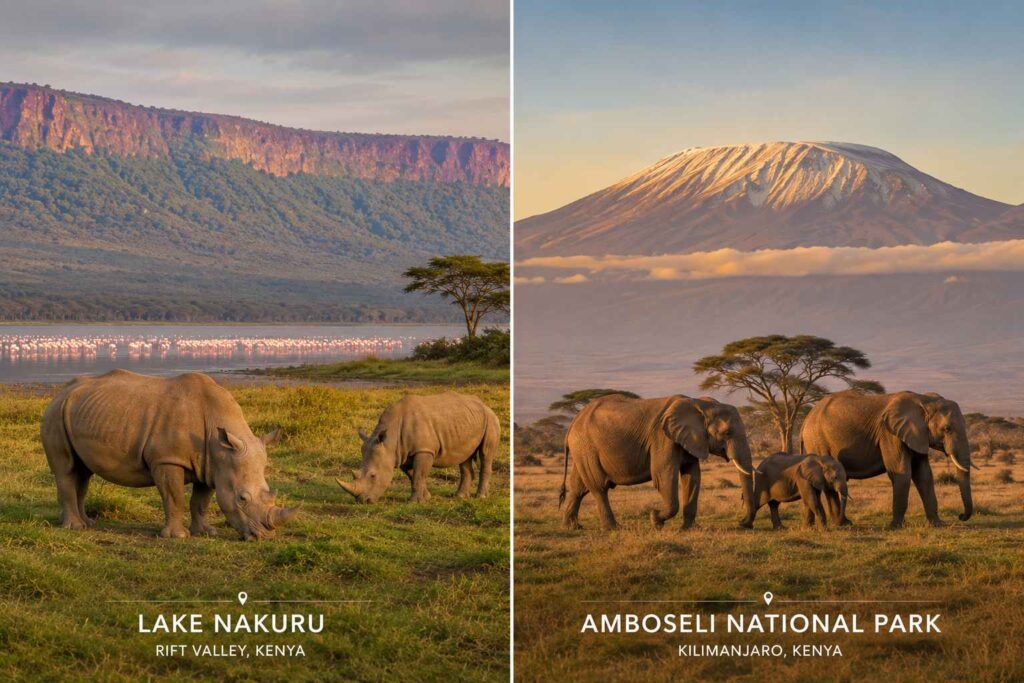
Lake Nakuru is compact, wildlife-rich, and famous for its thriving rhino population and diverse birdlife. Amboseli, meanwhile, is renowned for its enormous elephant herds and breathtaking views of Mount Kilimanjaro, creating one of Africa’s most photographed safari landscapes.
So which destination is right for you?
The answer depends on what you hope to see, how you like to travel, and the kind of safari experience you’re looking for.
At a glance
Both parks are excellent, but they specialize in different experiences.
Lake Nakuru
Best known for:
- White and black rhinos
- Leopards
- Birdlife
- Compact game drives
- Rift Valley scenery
Amboseli
Famous for:
- Large elephant herds
- Mount Kilimanjaro views
- Open plains
- Maasai culture
- Photography
Neither is objectively better—they simply appeal to different travel styles.
Wildlife at Lake Nakuru
Lake Nakuru National Park offers some of Kenya’s most reliable wildlife viewing.
Its protected ecosystem supports:
- White rhinos
- Black rhinos
- Lions
- Leopards
- Buffalo
- Rothschild’s giraffes
- Zebras
- Waterbucks
- Hyenas
Because the park is relatively compact, it’s possible to see an impressive variety of wildlife during a single game drive.
It’s also one of Kenya’s best destinations for spotting both rhino species.
Wildlife at Amboseli
Amboseli is one of Africa’s premier elephant destinations.
Visitors regularly encounter:
- Huge elephant family groups
- Lions
- Buffalo
- Giraffes
- Hyenas
- Zebras
- Wildebeest
- Hippos (around wetlands)
The park’s permanent swamps attract wildlife throughout the year, making animal viewing consistently rewarding even during dry periods.
Although leopards and cheetahs occur here, they’re generally less predictable than in some other Kenyan parks.
The elephant experience
If elephants are your priority, Amboseli has a clear advantage.
Its famous “super tuskers”—bull elephants with exceptionally large tusks—are among Kenya’s most celebrated wildlife icons.
Watching elephant families walk across the plains with Mount Kilimanjaro rising behind them is one of Africa’s classic safari moments.
For many photographers, this scene alone justifies the journey.
Rhinos: Nakuru’s biggest strength
While Amboseli excels with elephants, Lake Nakuru stands out for rhinos.
Thanks to decades of successful conservation, the park has become one of Kenya’s safest and most reliable places to see:
- White rhinos
- Black rhinos
Rhino sightings are often excellent, making Nakuru an ideal destination for travelers hoping to complete their Big Five checklist.
Landscapes
The scenery differs dramatically.
Lake Nakuru
Expect:
- Acacia woodland
- Rocky escarpments
- Grasslands
- Alkaline lake shoreline
Scenic viewpoints surrounding the lake provide spectacular panoramas of the Great Rift Valley.
Amboseli
Amboseli offers:
- Wide open plains
- Seasonal marshes
- Dusty savannah
- Acacia trees
- Mount Kilimanjaro dominating the skyline
Few safari destinations anywhere in Africa offer such iconic landscapes.
Birdwatching
Both parks are excellent for bird enthusiasts.
Lake Nakuru
Known for:
- Pelicans
- Flamingos (season permitting)
- Herons
- Storks
- Eagles
- Cormorants
Flamingo numbers fluctuate according to lake conditions, so large flocks cannot be guaranteed.
Amboseli
Birdlife includes:
- Crowned cranes
- Secretary birds
- Kori bustards
- Fish eagles
- Flamingos in seasonal wetlands
- Numerous waterbirds
The wetlands create excellent birdwatching throughout the year.
Photography
Both destinations are highly photogenic.
Choose Lake Nakuru for:
- Rhino photography
- Leopards
- Forest landscapes
- Birdlife
- Scenic viewpoints
Choose Amboseli for:
- Elephants
- Mount Kilimanjaro
- Sunrise photography
- Wide landscapes
- Dust-filled golden-hour scenes
Landscape photographers often consider Amboseli one of East Africa’s finest destinations.
Accessibility
Both parks are relatively easy to reach from Nairobi.
Lake Nakuru
Driving time:
- Approximately 3 to 4 hours
Amboseli
Driving time:
- Approximately 4 to 5 hours
Domestic flights are also available to Amboseli for travelers seeking faster connections.
Families and first-time safari travelers
Both parks are suitable for families.
Lake Nakuru’s compact size makes wildlife viewing efficient, which younger children often appreciate.
Amboseli’s spectacular scenery and frequent elephant sightings make it particularly memorable for first-time safari visitors.
Neither choice is likely to disappoint.
Accommodation
Both destinations offer accommodation ranging from budget-friendly lodges to luxurious safari camps.
Lake Nakuru
Accommodation is generally concentrated around the park boundary and nearby town.
Amboseli
Many lodges are positioned to maximize Kilimanjaro views, allowing guests to enjoy spectacular scenery even between game drives.
Luxury travelers will find excellent options in both parks.
Which destination suits your travel style?
Choose Lake Nakuru if you:
- Want reliable rhino sightings.
- Enjoy birdwatching.
- Prefer shorter game drives.
- Are interested in the Great Rift Valley.
Choose Amboseli if you:
- Dream of photographing elephants.
- Want iconic Kilimanjaro scenery.
- Love expansive landscapes.
- Are visiting Kenya for the first time.
Can you combine both?
Absolutely.
Many classic Kenya itineraries include:
- Amboseli
- Lake Naivasha
- Lake Nakuru
- Masai Mara
This route showcases several of Kenya’s most diverse ecosystems while avoiding unnecessary backtracking.
Combining Amboseli with Lake Nakuru offers an excellent balance of elephants, rhinos, birdlife, and contrasting landscapes.
Conclusion
Lake Nakuru and Amboseli each represent a different side of Kenya’s safari experience. Lake Nakuru is the ideal choice for travelers seeking exceptional rhino sightings, rewarding birdwatching, and compact game drives in the scenic Rift Valley. Amboseli, meanwhile, captivates visitors with its enormous elephant herds, sweeping plains, and unforgettable views of Mount Kilimanjaro.
If your itinerary allows, visiting both provides one of the most rewarding combinations in Kenya. But if time is limited, let your interests guide your decision: choose Nakuru for rhinos and diverse wildlife, or Amboseli for elephants, photography, and some of Africa’s most iconic safari scenery.
For more Kenya safari comparisons, destination guides, and travel planning advice, continue exploring the WhySafari blog.
FAQs
Amboseli is one of Africa’s best places to see elephants, particularly large family groups and impressive tuskers.
Lake Nakuru offers some of Kenya’s most reliable sightings of both black and white rhinos.
Both are excellent. Amboseli is famous for elephant photographs with Mount Kilimanjaro, while Lake Nakuru excels in rhino, birdlife, and woodland photography.
No. Cloud cover often hides the summit, especially later in the day. Early mornings usually provide the clearest views.
Both offer outstanding birdlife. Lake Nakuru is particularly known for waterbirds and seasonal flamingos, while Amboseli’s wetlands attract an impressive variety of species.
Yes. Many Kenya safari itineraries include both destinations alongside the Masai Mara or Lake Naivasha.
Amboseli is often recommended because of its spectacular scenery and abundant elephants, while Lake Nakuru is ideal for travelers prioritizing rhinos and compact wildlife viewing.