When most safari travelers hear the phrase “special five,” they immediately think of Africa’s famous Big Five. But in northern Kenya, another remarkable group of animals takes center stage: the Samburu Special Five.
These five species are uniquely adapted to the arid landscapes of northern Kenya and are rarely seen together anywhere else in East Africa. For many wildlife enthusiasts, spotting all five is just as rewarding as ticking off the Big Five.
The Samburu Special Five are one of the main reasons travelers venture beyond Kenya’s famous southern safari circuit to visit Samburu National Reserve and its surrounding conservancies.
Here’s what makes these animals so special, where to find them, and why they deserve a place on every safari bucket list.
What are the Samburu Special Five?
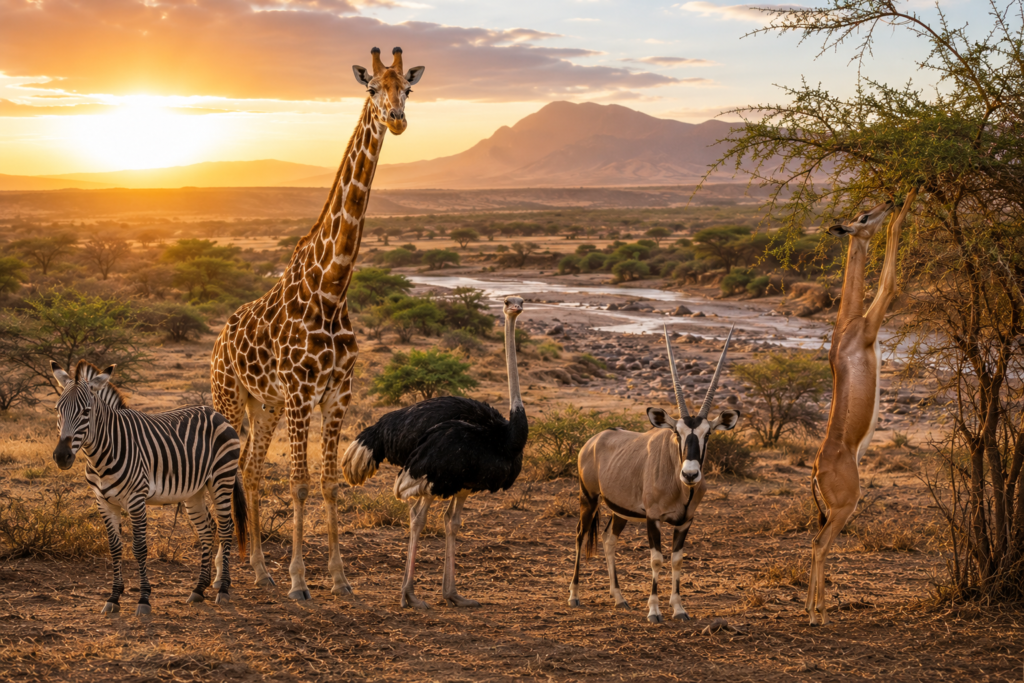
The Samburu Special Five are:
- Grevy’s zebra
- Reticulated giraffe
- Somali ostrich
- Beisa oryx
- Gerenuk
Unlike the Big Five—which were originally grouped because they were considered the most difficult animals to hunt on foot—the Samburu Special Five are linked by geography.
They are species primarily associated with northern Kenya’s dry ecosystems and are far less common in the country’s southern safari destinations such as the Masai Mara or Amboseli.
Many have evolved remarkable adaptations that allow them to survive in harsh, water-scarce environments.
Grevy’s zebra
The Grevy’s zebra is the largest and rarest of the world’s three zebra species.
Unlike the familiar plains zebra, Grevy’s zebras have:
- Narrow, closely spaced stripes
- Large rounded ears
- White underbellies
- Tall, mule-like appearance
They are exceptionally well adapted to arid habitats and can survive longer without drinking than other zebra species.
Unfortunately, Grevy’s zebra is endangered, with northern Kenya supporting one of its most important remaining wild populations.
Where to spot them
Samburu National Reserve, Buffalo Springs National Reserve, and nearby community conservancies provide some of the world’s best opportunities to observe Grevy’s zebras in their natural habitat.
They are often seen grazing alongside plains zebras, making comparisons particularly interesting.
Reticulated giraffe
Perhaps the most visually striking member of the Special Five, the reticulated giraffe is instantly recognizable by its bold geometric coat pattern.
Its sharply defined white lines separate large chestnut-colored patches, creating one of the most beautiful markings among Africa’s giraffe populations.
Reticulated giraffes browse primarily on acacia trees, using their long tongues to strip leaves while carefully avoiding thorns.
They often gather in loose social groups and are among the most photogenic animals in Samburu.
Where to spot them
Reticulated giraffes are common throughout Samburu National Reserve and surrounding conservancies, particularly near riverine woodland and open acacia habitats.
Somali ostrich
At first glance, the Somali ostrich may appear similar to the common ostrich found elsewhere in Africa, but closer observation reveals several important differences.
Male Somali ostriches have striking blue-gray necks and legs rather than the pinkish coloration seen in common ostriches.
They are also generally associated with the drier regions of East Africa and the Horn of Africa.
Their speed remains astonishing—they can run at more than 70 kilometers (43 miles) per hour when threatened.
Where to spot them
The open plains and semi-arid grasslands around Samburu provide excellent opportunities to observe Somali ostriches, often moving in pairs or small family groups.
Beisa oryx
Elegant and resilient, the Beisa oryx is perfectly adapted to desert and semi-desert conditions.
Its pale gray coat reflects sunlight, helping regulate body temperature, while its long, straight horns—present in both males and females—can exceed one meter in length.
Beisa oryx can survive for extended periods with very little free-standing water by obtaining moisture from vegetation.
Their calm behavior and striking appearance make them a favorite among photographers.
Where to spot them
Look for Beisa oryx in open bushland and dry grassland throughout Samburu National Reserve, Buffalo Springs, and neighboring conservancies.
Small herds are often seen browsing together.
Gerenuk
The gerenuk is perhaps the most unusual member of the Special Five.
Often called the “giraffe gazelle,” it possesses a remarkably long neck and slender body that allow it to feed in a unique way.
Unlike most antelope, gerenuks frequently stand upright on their hind legs to browse leaves from shrubs and low trees.
Watching one balance effortlessly while feeding several feet above the ground is one of Samburu’s most memorable wildlife spectacles.
Their shy nature means patience is often rewarded.
Where to spot them
Gerenuks favor thorny scrub and acacia bushland, where they browse quietly among dense vegetation.
They are regularly encountered throughout Samburu but often require attentive guides to locate.
Why are these species unique to northern Kenya?
Northern Kenya’s semi-arid environment differs dramatically from the greener savannahs farther south.
Lower rainfall, sparse vegetation, seasonal rivers, and thorny bush create conditions that favor species specially adapted to drought and limited water availability.
The Samburu Special Five have evolved behavioral and physiological traits that allow them to thrive where many other herbivores would struggle.
This ecological specialization makes northern Kenya one of East Africa’s most distinctive safari regions.
Where can you see all five?
Samburu National Reserve remains the best-known destination for spotting all five species.
However, nearby protected areas significantly increase your chances.
Excellent locations include:
- Samburu National Reserve
- Buffalo Springs National Reserve
- Shaba National Reserve
- Namunyak Conservancy
- Kalama Conservancy
Many safari itineraries combine several of these areas, allowing visitors to experience different habitats while searching for the complete Special Five.
How long does it take to see all five?
There is never a guarantee in wildlife viewing, but many visitors successfully see all five species during a three-day safari in Samburu.
Grevy’s zebras and reticulated giraffes are usually among the easiest to find.
The gerenuk sometimes requires more patience because of its cautious behavior and preference for thicker vegetation.
Experienced local guides dramatically improve your chances by knowing favored feeding areas and seasonal movement patterns.
The best time to visit
The Samburu Special Five can be seen throughout the year.
During the dry seasons—typically January to March and June to October—wildlife often gathers closer to permanent water sources, making sightings somewhat easier.
The green seasons bring beautiful scenery, fewer visitors, and excellent photography, although vegetation can occasionally make animals slightly more difficult to spot.
Unlike migration-dependent destinations, Samburu offers rewarding wildlife viewing in every season.
Beyond the Special Five
Although the Special Five are the reserve’s signature attraction, Samburu offers far more.
Visitors regularly encounter:
- Lions
- Leopards
- Cheetahs
- Elephants
- African wild dogs (occasionally)
- Crocodiles
- Hippos
- Hyenas
- More than 450 bird species
This impressive diversity means every game drive offers something new, even after completing the Special Five challenge.
Why they matter for conservation
Several members of the Samburu Special Five face growing conservation challenges.
Grevy’s zebra is endangered, while changing land use, prolonged droughts, habitat fragmentation, and climate change continue to affect wildlife across northern Kenya.
Protected areas such as Samburu National Reserve, together with neighboring conservancies and community-led conservation initiatives, play a vital role in safeguarding these species.
For visitors, seeing the Special Five is not only an exciting wildlife experience but also an opportunity to support responsible tourism that contributes to long-term conservation.
Conclusion
The Samburu Special Five showcase a side of African wildlife that many first-time safari travelers never expect to discover. Perfectly adapted to northern Kenya’s rugged landscapes, these remarkable animals offer a compelling reason to explore beyond the country’s better-known parks.
Whether you’re watching a gerenuk browse upright, photographing the striking pattern of a reticulated giraffe, or spotting endangered Grevy’s zebras grazing across the savannah, each encounter highlights the extraordinary biodiversity that makes Samburu so special.
For more Kenya wildlife guides, safari planning advice, and destination inspiration, continue exploring the WhySafari blog.
FAQs
They are Grevy’s zebra, reticulated giraffe, Somali ostrich, Beisa oryx, and gerenuk—five species strongly associated with northern Kenya’s semi-arid ecosystems.
No. The Big Five and the Samburu Special Five are completely different wildlife groupings. The Special Five are defined by their geographic distribution rather than historical hunting traditions.
Yes. Many visitors successfully spot all five during a three-day safari in Samburu, although wildlife sightings can never be guaranteed.
Habitat loss, competition with livestock, drought, and fragmentation of its range have contributed to significant population declines over recent decades.
Samburu is the best-known destination, but nearby reserves and conservancies such as Buffalo Springs, Shaba, Kalama, and Namunyak also support these species.
The gerenuk is often considered the most challenging because it is shy, well camouflaged, and prefers browsing in dense thorny vegetation.
They can be seen year-round, although the dry seasons generally offer easier wildlife viewing as animals concentrate around reliable water sources.