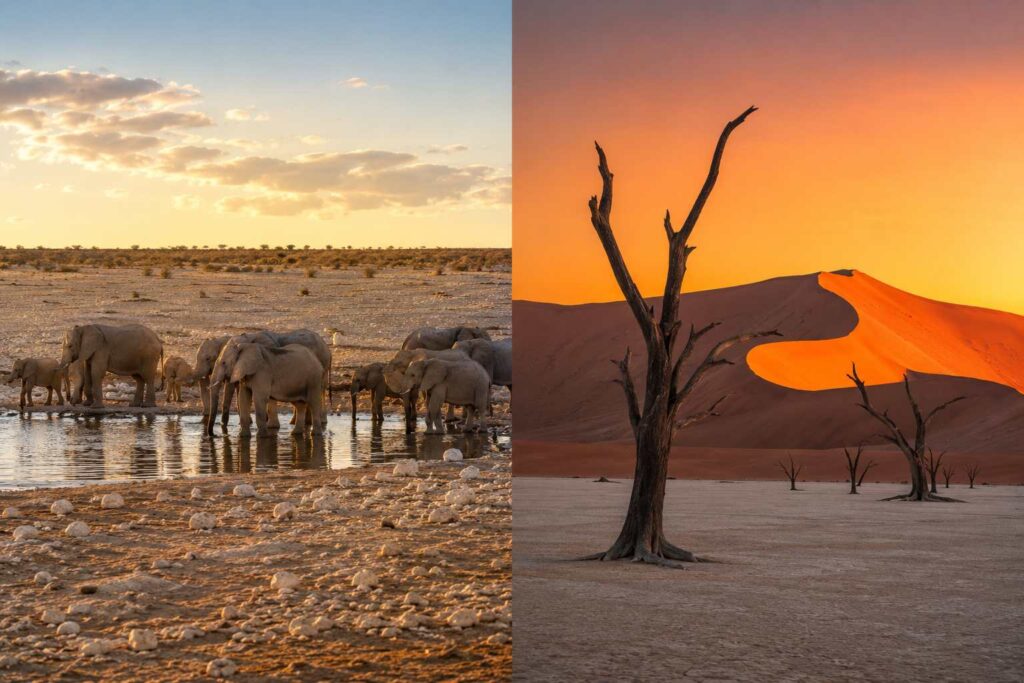
Namibia is unlike any other safari destination in Africa. While many countries are defined by their wildlife, Namibia offers two equally compelling but completely different travel experiences: the extraordinary wildlife of Etosha National Park and the breathtaking landscapes of the Namib Desert.
If you’re planning your first trip to Namibia and have limited time, you may wonder which destination deserves priority. Should you spend your days watching elephants gather around Etosha’s waterholes, or climb the towering red dunes of Sossusvlei in one of the world’s oldest deserts?
The good news is that there isn’t a wrong answer. The better question is: which experience best matches your travel style?
This guide compares Etosha and the Namib Desert to help you choose—or decide why combining both creates Namibia’s ultimate adventure.
At a glance
Although both destinations are among Namibia’s greatest highlights, they offer very different experiences.
Etosha National Park
Best known for:
- Outstanding wildlife viewing
- Self-drive safaris
- Waterhole photography
- Classic African game drives
- Dry-season animal concentrations
Namib Desert
Famous for:
- Towering sand dunes
- Sossusvlei and Deadvlei
- Epic landscapes
- Desert photography
- Hiking and scenic exploration
Etosha is primarily about wildlife.
The Namib Desert is primarily about landscapes.
Wildlife: Etosha takes the lead
If your dream safari revolves around animals, Etosha is the clear choice.
The park supports impressive populations of:
- Elephants
- Lions
- Leopards
- Black rhinos
- White rhinos (in some areas)
- Giraffes
- Zebras
- Springbok
- Oryx
- Wildebeest
- Hyenas
- Cheetahs
The famous Etosha Pan and its surrounding waterholes attract wildlife throughout the dry season, creating exceptional viewing opportunities.
One of the park’s biggest advantages is the ability to watch animals naturally gathering around permanent water sources.
Landscapes: The Namib Desert steals the show
Few places on Earth rival the scenery of the Namib Desert.
Highlights include:
- Sossusvlei
- Deadvlei
- Dune 45
- Big Daddy
- Sesriem Canyon
- Endless gravel plains
The towering red dunes, some among the tallest in the world, create landscapes that seem almost otherworldly.
Sunrise and sunset transform the sand into brilliant shades of orange, red, and gold.
For many travelers, the Namib offers Namibia’s most unforgettable scenery.
Wildlife in the Namib Desert
Although the Namib is not a traditional safari destination, it is far from empty.
Desert-adapted wildlife includes:
- Gemsbok (oryx)
- Springbok
- Ostriches
- Black-backed jackals
- Bat-eared foxes
- Brown hyenas
- Numerous reptiles and insects
The fascination lies in observing how animals survive in one of the world’s oldest and driest deserts.
However, wildlife sightings are generally less frequent and less varied than in Etosha.
Photography
Both destinations are exceptional for photographers.
Choose Etosha for:
- Wildlife action
- Predator encounters
- Waterhole behavior
- Night photography at floodlit camps
- Animal portraits
Choose the Namib Desert for:
- Landscapes
- Sunrise and sunset
- Minimalist compositions
- Astrophotography
- Iconic desert scenery
Landscape photographers often favor the Namib, while wildlife photographers naturally gravitate toward Etosha.
Activities
Etosha
The focus is on:
- Self-drive safaris
- Guided game drives
- Waterhole viewing
- Wildlife photography
Most activities revolve around finding and observing animals.
Namib Desert
Visitors enjoy:
- Climbing giant dunes
- Hiking
- Scenic drives
- Visiting Deadvlei
- Exploring Sesriem Canyon
- Hot air balloon flights
- Stargazing
The Namib offers greater variety for travelers interested in outdoor adventure.
Which destination is better for first-time visitors?
If you’re expecting a classic African safari, Etosha is likely to meet those expectations more closely.
If you’re fascinated by dramatic landscapes and unique natural environments, the Namib Desert provides an experience unlike anywhere else on Earth.
Many first-time visitors quickly discover that Namibia is less about choosing one over the other and more about appreciating how different each destination feels.
Families
Both destinations work well for families.
Etosha appeals to children because wildlife sightings are frequent and exciting.
The Namib captivates families with:
- Giant sand dunes
- Open spaces
- Easy walks
- Stunning scenery
- Opportunities to climb dunes
The choice depends largely on whether your family is more interested in animals or outdoor adventure.
Accessibility
Etosha
Etosha is easy to explore independently.
Its well-maintained roads and clearly marked routes make it one of Africa’s best self-drive safari parks.
Namib Desert
The Sossusvlei area is also accessible by self-drive, although some sections require four-wheel-drive vehicles or shuttle services for the final approach.
Both destinations are excellent for independent travelers.
Accommodation
Both regions offer accommodation ranging from budget campsites to luxurious lodges.
Etosha
Options include:
- Government rest camps
- Safari lodges
- Luxury camps
- Private reserves near the park
Namib Desert
Accommodation often emphasizes:
- Scenic desert settings
- Luxury tented camps
- Eco-lodges
- Stargazing experiences
Many desert lodges are attractions in their own right thanks to their spectacular locations.
Which suits your travel style?
Choose Etosha if you:
- Want a classic safari.
- Dream of seeing lions and elephants.
- Enjoy wildlife photography.
- Prefer game drives.
- Love observing animal behavior.
Choose the Namib Desert if you:
- Love dramatic landscapes.
- Enjoy hiking.
- Want iconic photography.
- Appreciate geology.
- Prefer adventure travel.
Why most travelers visit both
The beauty of Namibia lies in its diversity.
A typical itinerary combines:
- Windhoek
- Namib Desert
- Swakopmund
- Damaraland
- Etosha National Park
This route showcases deserts, coastlines, mountains, and wildlife in a single journey.
Rather than competing with one another, Etosha and the Namib complement each other perfectly.
Conclusion
Choosing between Etosha National Park and the Namib Desert isn’t about deciding which destination is better—it’s about deciding which experience speaks to you most. Etosha delivers one of Africa’s finest self-drive wildlife safaris, where elephants, rhinos, lions, and countless other animals gather around waterholes in unforgettable scenes. The Namib Desert, meanwhile, offers some of the planet’s most spectacular landscapes, from the towering dunes of Sossusvlei to the haunting beauty of Deadvlei.
If your schedule allows, combining both creates the ultimate Namibia adventure. Together, they reveal why this remarkable country is one of Africa’s most diverse and rewarding travel destinations.
For more Namibia travel guides, self-drive itineraries, and safari inspiration, continue exploring the WhySafari blog.
FAQs
Etosha National Park is Namibia’s premier wildlife destination, offering exceptional opportunities to see elephants, lions, rhinos, giraffes, and many other species.
Absolutely. While wildlife is less abundant, the Namib Desert offers some of the world’s most extraordinary landscapes and unforgettable outdoor experiences.
Yes. Most Namibia itineraries include both destinations, often alongside Swakopmund and Damaraland.
Wildlife photographers generally prefer Etosha, while landscape photographers often consider the Namib Desert one of the finest locations on Earth.
Both are excellent self-drive destinations with good infrastructure, although some desert routes require additional planning and, in certain areas, a 4WD vehicle.
Three days in Etosha and two to three days in the Namib Desert provide enough time to enjoy the highlights without feeling rushed.
If you imagine a traditional African safari, choose Etosha. If spectacular landscapes are your priority, the Namib Desert is the better fit.