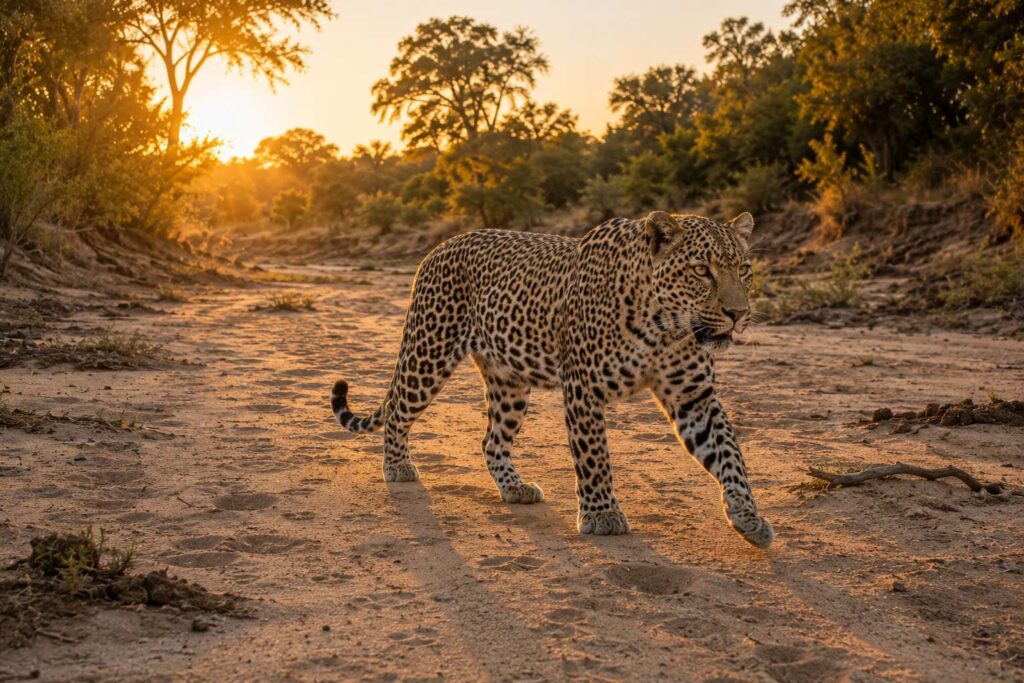
Few safari experiences compare to seeing a leopard in the wild. Silent, elusive, and beautifully camouflaged, these solitary cats are among the most sought-after sightings in Africa. While lions often dominate the open plains, leopards prefer to move unseen, blending effortlessly into riverine forests, rocky outcrops, and dense thickets.
The Greater Kruger ecosystem—which includes Kruger National Park and private reserves such as Sabi Sand, Timbavati, Klaserie, and Manyeleti—is widely regarded as one of the best places in Africa to observe leopards. But successful sightings are about much more than luck.
Understanding how leopards establish and defend territories helps explain why they’re regularly seen in certain areas, why guides return to familiar roads, and why individual cats can become well known to local trackers over many years.
Why Greater Kruger is famous for leopards
Greater Kruger offers almost ideal conditions for leopards.
The ecosystem provides:
- Healthy prey populations
- Mature riverine woodland
- Rocky outcrops
- Dense vegetation for cover
- Large protected landscapes
- Limited habitat fragmentation
Because wildlife moves freely across the unfenced Greater Kruger reserves, leopards can establish natural territories without being restricted by artificial barriers.
Combined with expert guides and trackers, this makes Greater Kruger one of Africa’s premier leopard destinations.
Leopards are solitary by nature
Unlike lions, leopards spend most of their lives alone.
Adults generally interact only for:
- Mating
- Mothers raising cubs
- Occasional temporary overlap between neighboring individuals
This solitary lifestyle explains why each leopard depends on a clearly defined home range that provides food, water, shelter, and suitable breeding habitat.
Protecting that territory is essential for survival.
What is a leopard territory?
A territory is the area a leopard regularly uses for hunting, resting, mating, and raising cubs.
Within that home range, leopards know:
- Reliable game trails
- Water sources
- Safe resting sites
- Trees suitable for storing prey
- Areas frequented by competitors
Although boundaries aren’t marked by fences, neighboring leopards recognize one another’s territories through scent marking and vocalizations.
Territories naturally change over time as younger animals establish themselves and older individuals disappear.
Male and female territories differ
Not all leopard territories are the same.
Male territories
Adult males usually occupy much larger territories.
Their ranges often overlap those of several females, increasing breeding opportunities while excluding rival males.
Male leopards regularly patrol their boundaries, reinforcing them through scent marking and vocal displays.
Female territories
Females generally maintain smaller, more stable territories focused on reliable food and safe denning sites.
A mother raising cubs benefits from familiarity with every part of her range, helping her avoid danger while locating prey efficiently.
These differences explain why guides may encounter the same female repeatedly within a relatively small area.
How leopards mark their territory
Leopards communicate constantly without needing to see one another.
Common territorial signals include:
- Scent marking
- Urine spraying
- Scratching tree trunks
- Claw marks
- Vocalizations such as rasping calls
These messages help reduce unnecessary confrontations by informing neighboring leopards that an area is already occupied.
Direct conflicts can still occur, particularly between competing males, but communication often prevents them.
Why riverbeds and drainage lines are leopard hotspots
One reason leopards are frequently seen near rivers is that these habitats provide ideal cover.
Riverine areas typically offer:
- Dense vegetation
- Shade
- Abundant prey
- Large trees
- Easy travel routes
Leopards often use dry riverbeds and drainage lines to move unseen through their territory.
For safari guides, these landscape features become natural places to search.
The importance of trees
Leopards are exceptional climbers.
Trees serve several purposes within a territory.
They provide:
- Safe resting places
- Shade during hot weather
- Elevated viewpoints
- Secure storage for prey
Dragging a freshly caught impala into a tree protects it from scavengers such as hyenas and lions.
This remarkable strength is one of the species’ defining characteristics.
Territory changes over time
A leopard’s territory isn’t permanent.
Several factors may alter its boundaries, including:
- Death of neighboring animals
- Young adults dispersing
- Seasonal prey movements
- Competition from rivals
- Habitat changes
Male territories tend to shift more than female territories because of ongoing competition.
Experienced guides often follow these changes over many years, allowing them to recognize familiar individuals and understand how the local leopard population evolves.
Why some private reserves are famous for leopard sightings
Private reserves such as Sabi Sand and Timbavati have earned global recognition for leopard viewing.
This isn’t because they contain a different species of leopard.
Instead, several factors combine to improve sightings:
- Experienced trackers
- Long-term knowledge of individual cats
- Off-road driving where permitted
- Consistent monitoring
- Stable leopard populations
Guides often know the territories of resident leopards so well that they can anticipate likely movements based on recent sightings and behavior.
Leopard behavior during the day
Leopards are often described as nocturnal, but that’s only part of the story.
In Greater Kruger they may be active:
- Early in the morning
- Late in the afternoon
- During the night
- On cool, overcast days
During hotter periods they frequently rest in thick vegetation or large trees before becoming active again as temperatures fall.
This is one reason sunrise and sunset game drives are so productive.
Reading the signs
Professional guides and trackers rarely rely on luck.
They look for subtle clues, including:
- Fresh tracks in sandy roads
- Alarm calls from impalas or monkeys
- Vultures gathering
- Recent scent marks
- Drag marks from prey
Each clue helps build a picture of where a leopard may be moving within its territory.
Guests often find this detective work just as fascinating as the sighting itself.
How visitors can improve their chances
Although sightings are never guaranteed, you can increase your chances by:
- Spending several days on safari.
- Joining experienced guided game drives.
- Being patient.
- Watching quietly.
- Looking into trees as well as along the ground.
- Choosing early morning or late afternoon drives.
Remember that observing natural behavior is often more rewarding than simply adding another species to a checklist.
Respecting leopard space
Leopards remain wild predators.
Responsible guides always maintain respectful viewing distances and avoid disturbing natural behavior.
Visitors should:
- Remain quiet.
- Avoid sudden movements.
- Never ask guides to pressure animals for better photographs.
- Appreciate the privilege of observing wildlife on its own terms.
Ethical wildlife viewing benefits both visitors and the animals themselves.
Conclusion
Understanding leopard territories adds a fascinating new dimension to any Greater Kruger safari. These remarkable cats are not wandering randomly through the bush—they are navigating carefully maintained home ranges shaped by prey availability, competition, and generations of natural behavior.
Whether you’re fortunate enough to watch a female leading cubs through her territory or a dominant male patrolling a riverbed at sunrise, every sighting becomes even more meaningful when you understand the hidden world behind it. In Greater Kruger, that blend of extraordinary wildlife and expert guiding is what makes leopard encounters some of the finest in Africa.
For more Greater Kruger guides, wildlife behavior articles, and safari planning tips, continue exploring the WhySafari blog.
FAQs
Healthy prey populations, suitable habitat, experienced guides, and the unfenced Greater Kruger ecosystem all contribute to consistently excellent leopard viewing.
Not always. Female territories are often relatively stable, while male territories can shift over time due to competition and changing populations.
Territory size varies depending on habitat, prey availability, and sex. Male home ranges are generally much larger than those of females.
Storing prey in trees helps protect it from scavengers such as hyenas and lions while allowing the leopard to feed over several days.
Yes. Although most active during dawn, dusk, and nighttime, leopards are regularly seen during daylight, particularly in cooler weather.
Often yes. In well-monitored reserves, experienced guides and trackers identify resident leopards by their unique spot patterns, scars, and behavior.
Sabi Sand, Timbavati, and several neighboring private reserves have earned outstanding reputations for regular leopard sightings thanks to experienced guiding and healthy leopard populations.