The Okavango Delta is one of Africa’s most extraordinary safari destinations, but reaching this remote wilderness is very different from visiting a typical national park. There are no major highways leading into the heart of the Delta, and many safari camps are accessible only by light aircraft or boat.
For first-time visitors, the logistics can seem complicated. In reality, getting to the Okavango Delta is surprisingly straightforward once you understand how Botswana’s safari transport network works.
Most journeys involve an international flight to Botswana, a domestic connection to either Maun or Kasane, followed by a scenic bush flight directly to your safari camp. From there, your adventure often begins with a game drive or boat transfer before you’ve even checked in.
This guide explains how to reach the Okavango Delta, the main access points, and what to expect during each stage of the journey.
Where is the Okavango Delta?
The Okavango Delta lies in northwestern Botswana, where the Okavango River spreads into a vast network of channels, lagoons, islands, floodplains, and wetlands before disappearing into the Kalahari Desert.
Unlike many safari destinations, the Delta isn’t concentrated around a single entrance gate. Instead, visitors stay in camps scattered across different private concessions and parts of Moremi Game Reserve.
Each camp has its own access route, making flights the most practical way to travel.
International flights to Botswana
Most international visitors reach Botswana through one of several regional gateways.
The most common options include:
- Johannesburg, South Africa
- Cape Town, South Africa (seasonal connections)
- Addis Ababa, Ethiopia
- Nairobi, Kenya (limited connections)
- Doha, Qatar (via regional routes)
- Windhoek, Namibia (select services)
From these hubs, travelers connect to Botswana’s domestic aviation network.
The exact route depends on your country of departure and safari itinerary.
Maun: The main gateway to the Delta
For most visitors, Maun is the primary gateway to the Okavango Delta.
Often called Botswana’s safari capital, Maun has a small but busy airport serving both scheduled domestic flights and charter safari aircraft.
Nearly every fly-in Delta itinerary passes through Maun.
After arriving, guests typically check in with their safari airline before boarding a light aircraft bound for their lodge.
The atmosphere is informal, and transfers between commercial and safari flights are generally straightforward.
Kasane: A convenient alternative
Kasane provides another important access point, particularly for travelers combining the Okavango Delta with Chobe National Park or Victoria Falls.
Located in Botswana’s far northeast, Kasane offers excellent international connections through nearby Zimbabwe and Zambia.
Several safari camps receive guests arriving via Kasane before continuing by light aircraft into the Delta.
This route is especially popular on multi-destination itineraries that include Chobe, the Okavango Delta, and Victoria Falls.
The bush flight experience
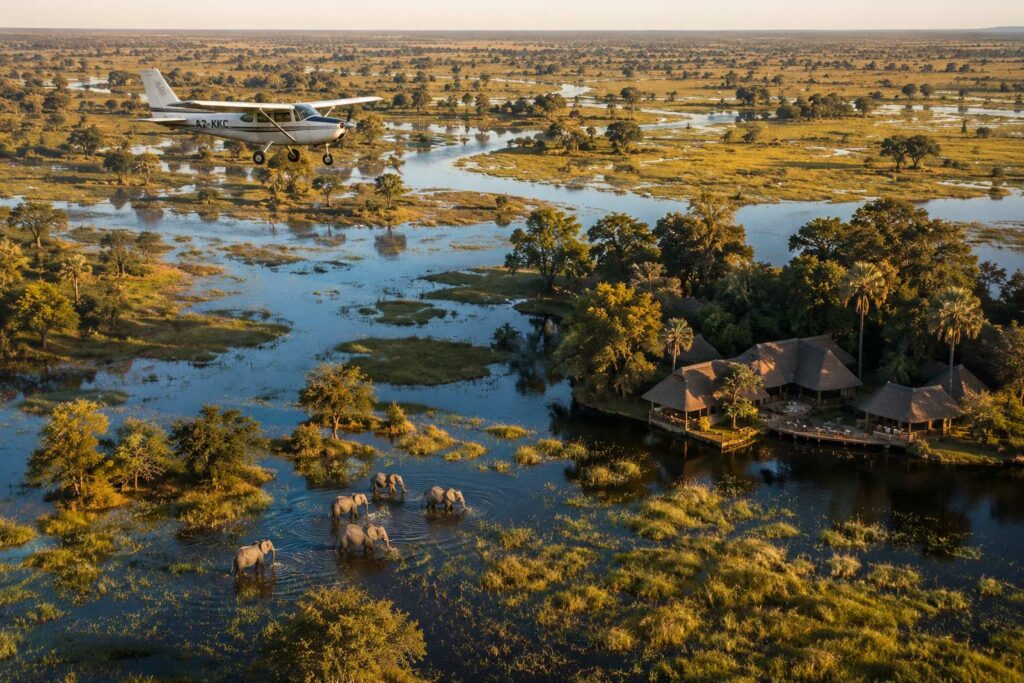
For many travelers, the bush flight becomes one of the highlights of the trip.
Small aircraft carrying between six and twelve passengers fly low enough to provide spectacular views of Botswana’s wilderness.
During the flight, you may see:
- Meandering waterways
- Elephant herds
- Hippos in lagoons
- Giraffes
- Buffalo
- Remote safari camps
- Endless floodplains
Because aircraft serve several camps on a single route, your flight may include one or two brief stops before reaching your destination.
The scenery alone makes the journey unforgettable.
Baggage restrictions
Bush flights use lightweight aircraft with strict luggage limits.
Most operators request:
- Soft-sided bags only
- Total luggage weight of approximately 20 kilograms (44 pounds), including hand luggage (limits vary slightly by airline and aircraft type)
Hard-shell suitcases generally cannot be accommodated because of limited cargo space.
Packing in a soft duffel bag makes transfers much easier and avoids unnecessary delays.
Transfers from the airstrip
Once you land, the safari has already begun.
Most camps meet arriving guests at nearby bush airstrips using open safari vehicles.
Depending on the location of your camp, the transfer may take anywhere from ten minutes to over an hour.
Wildlife sightings during these transfers are common, and many guests see elephants, giraffes, zebras, antelope, or even predators before reaching camp.
In wetter parts of the Delta, boat transfers may replace or complement vehicle transfers.
Can you drive to the Okavango Delta?
Technically, yes—but only to certain areas.
Visitors can drive to towns such as Maun and to parts of Moremi Game Reserve using a suitable four-wheel-drive vehicle.
However, most private Delta camps cannot be reached independently because they are located within remote floodplains accessible only by aircraft or specialized transfers arranged by the lodge.
Self-driving is generally recommended only for experienced overland travelers familiar with Botswana’s challenging sandy tracks and remote conditions.
Boat access
Water transport plays an important role in some parts of the Delta.
Depending on seasonal flood levels and camp location, guests may travel by:
- Motorboat
- Mokoro (traditional dugout canoe)
- Combined vehicle and boat transfer
These transfers are coordinated by your lodge and vary throughout the year as water levels rise and fall.
For many visitors, arriving by boat adds another memorable dimension to the safari experience.
Choosing the right access point
Your itinerary usually determines which gateway makes the most sense.
Choose Maun if you:
- Are visiting only the Okavango Delta.
- Plan to explore Moremi Game Reserve.
- Are starting or ending a Botswana safari.
- Want the widest choice of flight connections within Botswana.
Choose Kasane if you:
- Are combining Chobe National Park with the Delta.
- Plan to visit Victoria Falls.
- Are following a northern Botswana safari circuit.
- Want to include multiple countries in one trip.
Both airports provide excellent access to the Delta.
Can you combine the Delta with other destinations?
Absolutely.
Many Botswana itineraries combine the Okavango Delta with:
- Chobe National Park
- Moremi Game Reserve
- Makgadikgadi Pans
- Central Kalahari Game Reserve
- Victoria Falls
- Hwange National Park in Zimbabwe
Domestic bush flights make these combinations surprisingly efficient despite the vast distances involved.
Most safari operators handle all logistics, allowing travelers to focus entirely on the experience.
Travel tips before you fly
Preparing for bush flights is simple with a little planning.
Before departure:
- Pack in a soft-sided duffel bag.
- Keep cameras and binoculars easily accessible.
- Carry medications in your hand luggage.
- Wear lightweight clothing suitable for warm weather.
- Expect brief security procedures at regional airports.
- Confirm luggage limits with your safari operator.
Because aircraft often fly at lower altitudes than commercial airlines, keep your camera ready—the views are spectacular from takeoff to landing.
Is getting to the Delta difficult?
Not at all.
Although the Okavango Delta feels wonderfully remote, Botswana has developed one of Africa’s most efficient safari transport systems.
Most visitors find that transfers are carefully coordinated, luggage handling is straightforward, and safari operators manage every stage of the journey.
In fact, many travelers discover that reaching the Delta becomes part of the adventure itself.
Conclusion
Getting to the Okavango Delta is easier than many first-time visitors expect. Whether you arrive through Maun or Kasane, the combination of bush flights, game-drive transfers, and boat journeys creates a seamless introduction to one of Africa’s most remarkable wilderness destinations.
The journey itself is part of the safari, offering unforgettable aerial views, early wildlife sightings, and a growing sense of adventure long before you reach camp. With logistics handled by experienced safari operators, all that’s left is to enjoy the experience.
For more Botswana travel guides, safari planning advice, and destination comparisons, continue exploring the WhySafari blog.
FAQs
Maun is the primary gateway for most Delta safaris, while Kasane is ideal for itineraries that also include Chobe National Park or Victoria Falls.
Usually not. Most Delta camps are accessible only by light aircraft, boat, or lodge-operated transfers from nearby airstrips.
Most bush flights last between 20 and 60 minutes, depending on your camp location and the number of stops along the route.
Light aircraft have limited cargo space, and soft-sided bags fit much more easily into the aircraft’s storage compartments.
Yes. Botswana’s safari aviation industry is well established, and flights are operated by experienced pilots using routes specifically designed for remote safari travel.
Absolutely. This is one of southern Africa’s most popular safari itineraries, with convenient flight connections via Kasane.
Some operators offer scenic helicopter flights as an optional activity or premium transfer, although standard access to most camps is by fixed-wing bush aircraft.