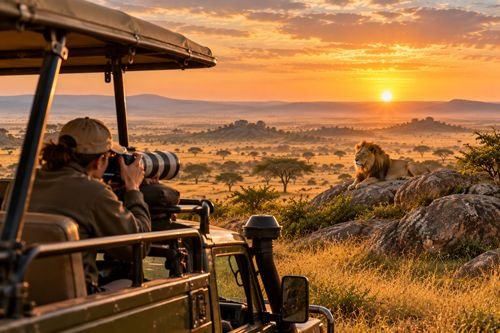
Imagine photographing a lion illuminated by the first golden rays of sunrise, a cheetah scanning the grasslands from a termite mound, or thousands of wildebeest crossing the Serengeti plains. For wildlife photographers, few destinations offer such extraordinary opportunities.
Tanzania’s Serengeti National Park is famous for its abundant wildlife, diverse landscapes, and dramatic natural events. But capturing memorable photographs requires more than bringing a good camera and hoping for exciting sightings.
The quality of your images depends on when you travel, where you stay, how your safari vehicle is arranged, and how much time you spend observing animal behavior.
So, is the Serengeti good for wildlife photography? Absolutely. Its open landscapes, exceptional predator populations, and seasonal Great Migration make it one of Africa’s most rewarding photography destinations.
However, planning a photography-focused safari is different from organizing a conventional wildlife tour.
This Serengeti photography safari guide explains the best seasons and locations, essential camera equipment, vehicle considerations, and practical techniques for capturing better wildlife photographs.
Choosing the right Serengeti region is one of the most important steps in planning a wildlife photography safari. Each area offers different landscapes, animal habitats, and seasonal opportunities. Before finalizing your photography itinerary, explore our complete Serengeti National Park safari guide to understand the park’s main regions, wildlife highlights, and accommodation options.
Why the Serengeti is ideal for wildlife photography
The Serengeti offers an extraordinary combination of wildlife abundance and diverse photographic environments.
Its vast grasslands provide unobstructed views of animals moving across the plains, while rocky kopjes, riverine woodland, and scattered acacia trees create striking natural compositions.
Lions, leopards, cheetahs, elephants, giraffes, zebras, and numerous antelope species offer opportunities for everything from intimate animal portraits to dramatic environmental photographs.
The Great Migration adds another dimension, with enormous wildebeest herds moving through the ecosystem throughout the year.
Unlike destinations where vegetation frequently obstructs wildlife, many Serengeti habitats allow photographers to observe animals across substantial distances.
However, this also means a long telephoto lens is useful, particularly because vehicles must remain on permitted routes.
For photographers, the Serengeti’s greatest advantage is variety: you can photograph predator behavior, sweeping landscapes, colorful birds, and large herds within the same trip.
Best time for a Serengeti photography safari
The best month depends on the photographs you want to capture.
| Season | Best photographic subjects | Recommended area |
|---|---|---|
| January–March | Wildebeest calves, predators, green plains | Southern Serengeti and Ndutu |
| April–May | Dramatic skies, lush landscapes, fewer vehicles | Central Serengeti |
| June–July | Large herds, dry-season light, migration movements | Western and Northern Serengeti |
| August–September | Mara River crossings, wildebeest herds | Northern Serengeti |
| October–December | Resident wildlife, changing landscapes, birdlife | Central and seasonal southern areas |
Migration movements depend on rainfall, so these periods are approximate rather than guaranteed.
January to March: Predators and calving season
The southern Serengeti ecosystem, especially Ndutu, offers remarkable photography opportunities during the wildebeest calving season.
Newborn animals attract predators, creating opportunities to observe lions, cheetahs, and hyenas.
Fresh grass provides attractive backgrounds, while storm clouds can create dramatic lighting.
Much of Ndutu lies in the Ngorongoro Conservation Area, where access and photography arrangements differ from those inside Serengeti National Park.
June to October: Migration and golden landscapes
The dry season is particularly attractive for photographing wildlife against golden grasslands.
As vegetation becomes thinner, animals are often easier to locate.
Between approximately July and October, Northern Serengeti provides opportunities to photograph wildebeest near the Mara River.
However, river crossings are unpredictable, and photographers should allow multiple days rather than expecting a dramatic event on demand.
Best Serengeti regions for wildlife photography
Selecting the right region can be more important than choosing an expensive camera.
Central Serengeti: Big cats and year-round photography
The Seronera Valley is an excellent choice for first-time wildlife photographers.
Lions frequently use granite kopjes as resting places, while leopards inhabit riverine woodland.
Cheetahs can be encountered on the surrounding open plains.
Central Serengeti supports resident wildlife throughout the year, making it especially suitable for photographers traveling outside migration-focused seasons.
Northern Serengeti: Dramatic migration photography
Northern Serengeti is particularly appealing to experienced photographers interested in movement, action, and large wildlife concentrations.
The Mara River provides opportunities for dramatic images, but crossings can happen suddenly or not at all.
A long telephoto lens, fast shutter speeds, and patience are especially valuable here.
Southern and Western Serengeti: Seasonal variety
Southern Serengeti offers predator-prey interactions and calving-season photography.
The Western Corridor provides river landscapes, woodland habitats, and seasonal migration activity.
Choosing between these regions should depend on your travel month and the species or behaviors you most want to photograph.
How many days do you need for a Serengeti photography safari?
For serious wildlife photography, four to five nights in the Serengeti is a sensible starting point.
This provides several opportunities to photograph animals in different lighting conditions.
A longer stay of six to eight nights is particularly valuable if you want to explore multiple regions or focus on migration behavior.
Photographers benefit from spending extended periods at promising sightings rather than constantly moving between locations.
If you’re hoping to capture Mara River crossings, consider spending at least three or four nights in Northern Serengeti during the appropriate season.
Extra time increases opportunities, but no wildlife encounter is guaranteed.
Private safari vehicle vs shared game drives
Your vehicle arrangement can have a major influence on your photographs.
A private safari vehicle is often worth considering because it gives you more control over wildlife stops, departure times, and shooting positions.
You can remain with an interesting animal, wait for better light, or ask your guide to adjust the vehicle’s position where permitted.
Shared game drives can still produce excellent photographs, but passengers may have different priorities.
For dedicated photography trips, ask about window seats, roof openings, vehicle capacity, and camera support.
A safari guide who understands lighting, backgrounds, and animal behavior is often more valuable than expensive equipment alone.
Essential camera gear for a Serengeti safari
You don’t need professional equipment to enjoy wildlife photography, but a flexible camera setup helps.
Telephoto lenses for wildlife
A 100–400mm or 150–600mm zoom lens provides useful reach for photographing distant animals.
Longer focal lengths are particularly valuable for birds, leopards resting in trees, and animals that cannot be approached closely.
A lens with image stabilization can help reduce camera shake.
Wide-angle lenses for landscapes
A 24–70mm lens is useful for photographing vast plains, dramatic skies, safari camps, and animals within their wider environment.
Including the landscape often creates more memorable photographs than filling every frame with an animal.
Useful accessories
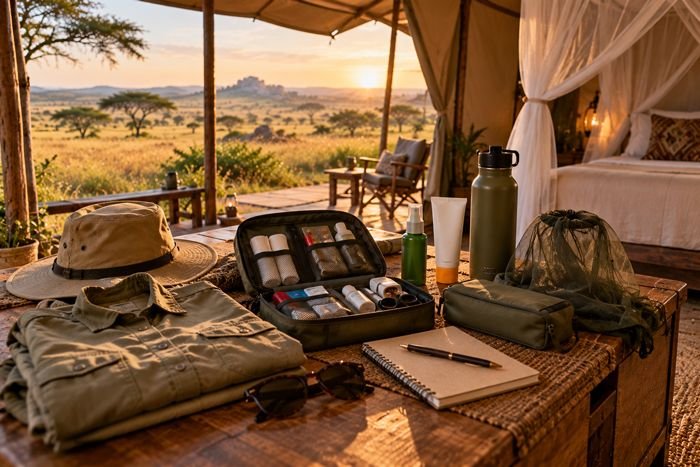
Bring spare batteries, memory cards, cleaning supplies, and protective camera covers.
A beanbag can stabilize a long lens against a vehicle’s window frame or roof opening.
Dust is common during the dry season, so avoid changing lenses unnecessarily in exposed conditions.
If flying on small safari aircraft, confirm luggage weight restrictions before packing heavy camera equipment.
Camera settings for better Serengeti wildlife photos
Wildlife photography often involves movement and rapidly changing light.
Continuous autofocus and subject tracking can help keep moving animals sharp.
For stationary wildlife, shutter speeds around 1/250 to 1/500 second may work, depending on lens stability and focal length.
Walking animals often benefit from approximately 1/500 second or faster.
For running predators, birds in flight, or dramatic river crossings, 1/1000 to 1/2000 second or faster may be appropriate.
Using Auto ISO can help maintain suitable shutter speeds as lighting changes.
These are starting points rather than fixed rules. Adjust your settings according to subject movement, available light, camera capability, and desired creative effect.
How to use natural light on a Serengeti safari
Early morning and late afternoon generally offer the most flattering wildlife photography conditions.
The low sun creates warm tones, softer shadows, and beautiful highlights on animal fur.
Backlighting can produce dramatic silhouettes, particularly when photographing giraffes, elephants, or animals moving through dust.
Midday sunlight is usually harsher, but it can still work for high-contrast compositions, behavior photography, or animals resting in shade.
Cloudy skies can also provide softer, more even illumination.
Rather than stopping photography when conditions aren’t perfect, adapt your compositions to the light available.
Ethical wildlife photography in the Serengeti
Responsible photography should always prioritize animal welfare.
Never ask your guide to chase wildlife, block an animal’s movement, or approach beyond permitted distances.
Avoid loud noises, flash photography that may disturb animals, or attempts to provoke reactions for the camera.
Inside Serengeti National Park, vehicles must follow established driving restrictions, and visitors cannot leave vehicles except where permitted.
Drones also require specific authorization and should never be used without the necessary permissions.
The best wildlife images capture natural behavior without changing it.
Common Serengeti photography mistakes to avoid
One common mistake is concentrating entirely on the Big Five while overlooking smaller subjects.
Birds, insects, animal tracks, and interactions between grazing species can produce wonderful photographs.
Another mistake is taking thousands of images without considering composition.
Look for clean backgrounds, interesting light, and moments that tell a story.
Avoid packing too many lenses if weight restrictions or frequent equipment changes will make photography difficult.
Most importantly, don’t rush every sighting.
Sometimes the best photograph appears after twenty minutes of patient observation, when an animal finally moves into beautiful light or interacts naturally with its surroundings.
Final thoughts: Planning your perfect Serengeti photography safari
The Serengeti is one of the world’s most rewarding destinations for wildlife photography, offering extraordinary subjects throughout the year.
However, memorable images depend on more than camera specifications.
Choosing the right season, staying in suitable wildlife areas, traveling with an experienced guide, and allowing sufficient time at sightings can transform your experience.
Whether you’re photographing lions at sunrise, migration herds on the plains, or elephants beneath dramatic skies, patience and respect for wildlife are essential.
For more photography inspiration, seasonal wildlife guides, and practical Tanzania safari advice, explore the WhySafari blog and start planning your next African adventure.
Frequently asked questions about Serengeti photography safaris
Absolutely. Beginners can capture excellent images with entry-level cameras or smartphones. A photography-focused guide or workshop can help with composition, exposure, and wildlife behavior, making the experience educational as well as rewarding.
Modern smartphones can capture excellent landscapes, videos, and animals near the vehicle. However, their limited optical zoom makes distant wildlife more challenging. A camera with a telephoto lens offers greater flexibility for detailed animal portraits.
Some specialized photography operators can arrange camera or lens rentals, but availability varies. Confirm equipment models, insurance requirements, and collection arrangements before traveling rather than assuming rental gear will be available at camp.
Yes. Specialist safari companies organize photography-focused departures that may include professional tuition, image reviews, and dedicated vehicle arrangements. These experiences are particularly useful for travelers seeking to improve their technical skills.
Yes. Balloon safaris offer a different perspective on the landscape and large wildlife herds. However, basket movement, changing altitude, and limited control over the flight path make photography more challenging than shooting from a stationary vehicle.
RAW provides greater flexibility when adjusting exposure, white balance, and shadows during editing. JPEG files take up less storage and are easier to share. Shooting RAW+JPEG can be a practical choice when your camera and storage capacity allow.
Bring sufficient memory cards and consider a portable SSD or laptop for daily backups. Ideally, maintain two copies of important images on separate devices. Remote safari camps may have limited internet access, making cloud-only backups unreliable.
Full-size tripods are often impractical inside safari vehicles because of restricted space and movement. Beanbags or compact supports are generally more convenient. A tripod may be useful at permitted accommodation viewpoints, subject to property rules.