When people think of a South African safari, destinations like Kruger National Park or Madikwe Game Reserve usually come to mind. Yet in the country’s remote northwest lies one of Africa’s most extraordinary wilderness areas—Kgalagadi Transfrontier Park.
Stretching across the border between South Africa and Botswana, Kgalagadi offers a safari unlike any other. Instead of dense bush and permanent rivers, you’ll find endless red sand dunes, fossil riverbeds, dramatic desert skies, and predators perfectly adapted to one of the harshest environments on Earth.
This is a place where black-maned lions patrol ancient dry river valleys, cheetahs hunt across open plains, and enormous raptors soar overhead against cloudless blue skies.
For travelers seeking solitude, spectacular landscapes, and unforgettable predator sightings, Kgalagadi may be South Africa’s greatest hidden safari destination.
What is Kgalagadi Transfrontier Park?
Kgalagadi Transfrontier Park is one of Africa’s first international peace parks.
Created through the cooperation of South Africa and Botswana, it combines South Africa’s former Kalahari Gemsbok National Park with Botswana’s Gemsbok National Park into a single protected ecosystem.
Together they protect more than 38,000 square kilometers (14,700 square miles) of semi-arid wilderness, making Kgalagadi one of the largest conservation areas in southern Africa.
Wildlife moves freely across international boundaries, creating a vast, uninterrupted landscape where natural ecological processes continue much as they have for thousands of years.
A landscape unlike anywhere else
The first thing visitors notice isn’t the wildlife—it’s the scenery.
Kgalagadi is defined by:
- Towering red sand dunes
- Ancient dry riverbeds
- Golden grasslands
- Camel thorn trees
- Endless horizons
- Brilliant blue skies
Unlike wetter safari destinations, water is scarce.
Wildlife concentrates around natural and artificial waterholes scattered along the fossil river valleys of the Nossob and Auob rivers.
These open landscapes also make wildlife surprisingly easy to spot.
Why predator sightings are exceptional
Kgalagadi has earned a reputation as one of Africa’s premier predator destinations.
Its open terrain allows visitors to observe hunting behavior that might remain hidden in denser habitats.
The park is especially famous for:
- Black-maned Kalahari lions
- Cheetahs
- Leopards
- Brown hyenas
- Spotted hyenas
- African wild cats
- Caracals (occasionally)
Because vegetation is relatively sparse, animals can often be watched from considerable distances without disturbing their natural behavior.
Patience frequently rewards visitors with unforgettable predator encounters.
Meet the legendary black-maned lions
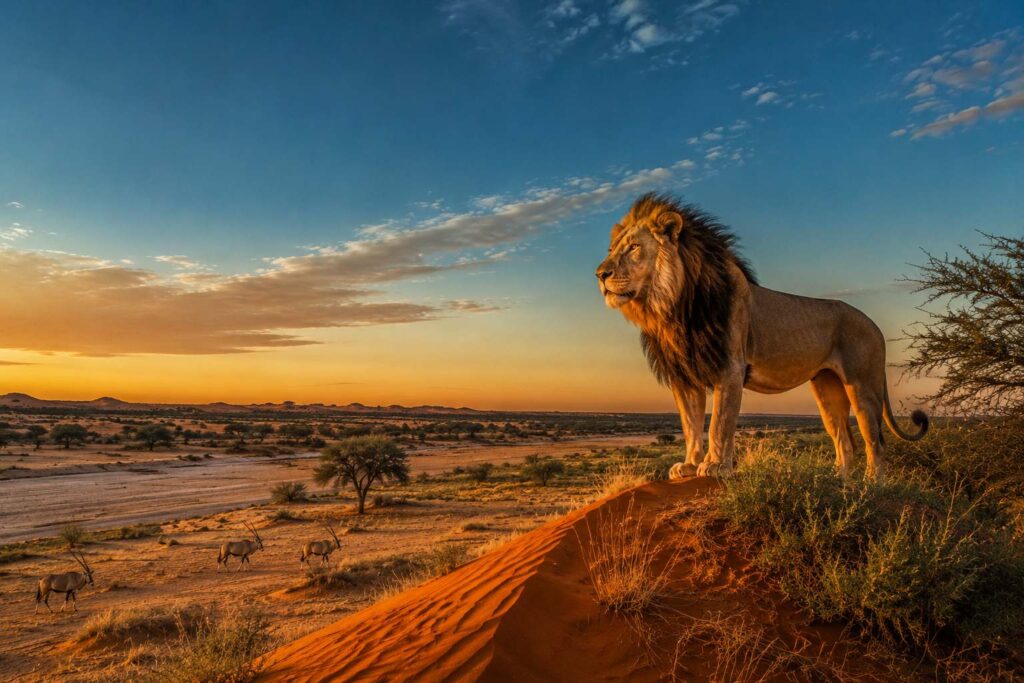
Perhaps no animal symbolizes Kgalagadi more than the magnificent black-maned Kalahari lion.
These impressive males develop darker, fuller manes than many lions elsewhere in Africa, an adaptation believed to be influenced by genetics and the region’s climate.
Watching one of these lions standing atop a red dune at sunrise has become one of southern Africa’s most iconic wildlife experiences.
Although they are the same species as lions found elsewhere, their appearance and the dramatic desert setting make every sighting unforgettable.
A paradise for birdwatchers
Kgalagadi is also one of South Africa’s finest birding destinations.
Large birds of prey thrive in the open landscape.
Visitors frequently encounter:
- Martial eagles
- Tawny eagles
- Pale chanting goshawks
- Secretary birds
- Bateleurs
- Falcons
- Vultures
- Owls
The excellent visibility allows birdwatchers and photographers to observe raptors soaring across vast desert skies.
Even casual wildlife enthusiasts quickly become fascinated by the park’s remarkable birdlife.
Unique desert-adapted wildlife
Beyond its famous predators, Kgalagadi supports an impressive variety of mammals adapted to arid conditions.
Look for:
- Gemsbok
- Springbok
- Blue wildebeest
- Eland
- Bat-eared foxes
- Meerkats
- Cape foxes
- Honey badgers
- Ground squirrels
Many species have evolved specialized behaviors that help them survive in one of Africa’s driest environments.
Learning about these adaptations becomes one of the most fascinating aspects of visiting the park.
A dream destination for photographers
Few safari destinations offer better photographic conditions.
The combination of:
- Open landscapes
- Golden light
- Minimal vegetation
- Dramatic skies
- Rich red dunes
creates spectacular opportunities throughout the day.
Photographers particularly appreciate sunrise and sunset, when warm light transforms the dunes into brilliant shades of orange and crimson.
Dust trails behind wildlife often add even more drama to images.
Self-drive safaris at their best
Kgalagadi is one of South Africa’s finest self-drive safari destinations.
Well-maintained roads allow visitors to explore independently while moving slowly between waterholes and viewpoints.
Driving yourself offers:
- Complete flexibility
- Longer wildlife observations
- Excellent photography opportunities
- A stronger sense of adventure
Because visitor numbers remain relatively low, you’ll often have sightings entirely to yourself.
A high-clearance vehicle is recommended for some routes, particularly if exploring Botswana’s wilderness sections.
Accommodation options
Visitors can choose from several accommodation styles.
Options include:
- SANParks rest camps
- Wilderness camps
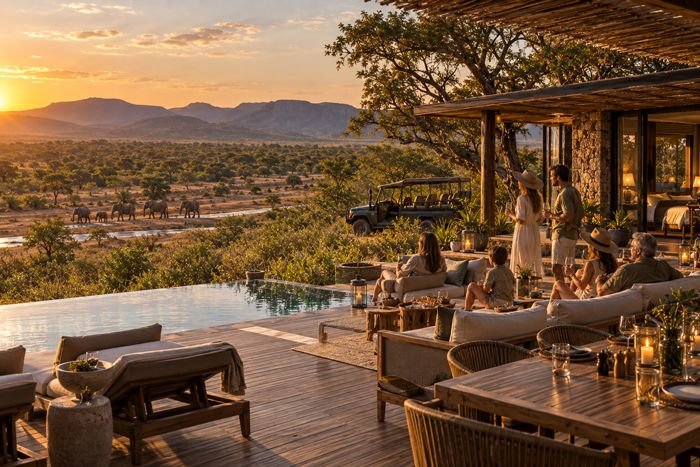
- Luxury lodges near the park
- Self-catering chalets
- Campsites
The remote wilderness camps are especially popular with travelers seeking complete solitude and unforgettable night skies.
Reservations should be made well in advance, particularly during peak travel periods.
When is the best time to visit?
Kgalagadi offers rewarding safaris throughout the year.
Dry winter (May to September)
This is the most popular season.
Advantages include:
- Mild daytime temperatures
- Cold nights
- Excellent predator sightings
- Comfortable self-driving
- Beautiful clear skies
Summer (October to April)
Summer brings dramatic thunderstorms and occasional rainfall.
Visitors enjoy:
- Green landscapes
- Migratory birds
- Baby antelope
- Spectacular cloud formations
Temperatures can become extremely hot, particularly during midday.
Is Kgalagadi suitable for first-time safari travelers?
Yes, although it’s different from Kruger.
Travelers expecting dense concentrations of elephants and buffalo may be surprised by the desert environment.
However, visitors who appreciate:
- Landscapes
- Predators
- Birdlife
- Photography
- Solitude
often consider Kgalagadi one of Africa’s most rewarding safari destinations.
The slower pace encourages deeper observation of wildlife behavior and the unique ecology of the Kalahari.
Practical travel tips
Before visiting:
- Fill your fuel tank whenever possible.
- Carry plenty of drinking water.
- Download offline maps.
- Bring binoculars.
- Pack warm clothing for winter mornings.
- Reserve accommodation well in advance.
Cell phone coverage is limited in remote areas, adding to the reserve’s true wilderness atmosphere.
Why Kgalagadi deserves more attention
Kgalagadi isn’t simply another safari destination.
It offers an entirely different vision of Africa.
Instead of lush savannahs, you’ll experience silence, space, extraordinary skies, and wildlife perfectly adapted to one of the continent’s most demanding landscapes.
For many repeat safari travelers, these qualities make Kgalagadi one of South Africa’s most unforgettable national parks.
Conclusion
Kgalagadi Transfrontier Park offers one of Africa’s most distinctive safari experiences. Its vast red dunes, legendary black-maned lions, exceptional predator sightings, and remarkable sense of solitude set it apart from more traditional safari destinations.
Whether you’re a wildlife photographer, an avid birder, or simply looking for a safari beyond the usual tourist trail, Kgalagadi rewards patience with unforgettable encounters and breathtaking desert scenery. It’s a place where the landscape is just as captivating as the wildlife—and where every sunrise over the Kalahari feels like an adventure.
For more South Africa safari guides, destination comparisons, and travel inspiration, continue exploring the WhySafari blog.
FAQs
The park lies on the border between South Africa and Botswana, protecting a vast section of the southern Kalahari Desert.
The park is especially renowned for its black-maned Kalahari lions, cheetahs, leopards, brown hyenas, and impressive birds of prey.
Yes. It is widely regarded as one of South Africa’s best self-drive safari destinations thanks to excellent roads, low visitor numbers, and outstanding wildlife viewing.
A standard vehicle is suitable for most South African tourist roads, but a high-clearance 4×4 is recommended for certain wilderness routes and the Botswana section of the park.
The dry winter months from May to September generally provide the most comfortable weather and excellent predator sightings, although the summer green season has its own unique appeal.
No. While the park has lions and leopards, it does not support the full Big Five. Its appeal lies in desert-adapted wildlife, predator behavior, and spectacular landscapes rather than traditional Big Five safaris.
Three to five days is ideal for most visitors, allowing enough time to explore different sections of the park and enjoy multiple game drives without rushing.