When people imagine Namib-Naukluft National Park, they usually picture the towering orange sand dunes of Sossusvlei. These iconic landscapes have become synonymous with Namibia, appearing in countless travel magazines, documentaries, and photography books.
But reducing Namib-Naukluft to its famous dunes overlooks the true scale and diversity of this extraordinary wilderness.
Stretching across nearly 50,000 square kilometers (19,300 square miles), Namib-Naukluft is one of Africa’s largest national parks. Within its boundaries, you’ll find ancient deserts, dramatic mountain ranges, hidden canyons, gravel plains, unique desert wildlife, and some of the oldest landscapes on Earth.
Whether you’re a photographer, a hiker, a self-drive adventurer, or simply someone fascinated by wild places, Namib-Naukluft offers far more than its postcard-famous scenery.
Where is Namib-Naukluft National Park?
Namib-Naukluft National Park lies in western Namibia, stretching from the Atlantic coastline deep into the interior.
The park encompasses several distinct regions, including:
- Sossusvlei
- Deadvlei
- Sesriem Canyon
- The Naukluft Mountains
- Vast gravel plains
- Remote desert wilderness
Because of its immense size, many visitors explore only the Sossusvlei area. However, those with more time discover a park of remarkable ecological diversity.
Home to one of the world’s oldest deserts
The Namib Desert is believed to be one of the oldest deserts on Earth, with arid conditions that have persisted for millions of years.
This incredible age has allowed plants and animals to evolve extraordinary survival strategies.
Unlike many deserts that appear lifeless, the Namib supports a surprising variety of specially adapted species capable of surviving with minimal rainfall.
The result is an ecosystem unlike anywhere else in Africa.
Sossusvlei: The famous dunes
Sossusvlei remains the park’s most visited attraction—and for good reason.
Here, enormous star-shaped dunes rise hundreds of meters above the surrounding salt and clay pans.
Some of the most famous include:
- Big Daddy
- Big Mama
- Dune 45
- Elim Dune
Their constantly changing colors—from deep red at sunrise to brilliant orange and soft gold later in the day—make them some of the world’s most photographed landscapes.
Climbing one of these dunes before sunrise is an unforgettable experience.
Deadvlei: Namibia’s most iconic landscape
A short distance from Sossusvlei lies Deadvlei.
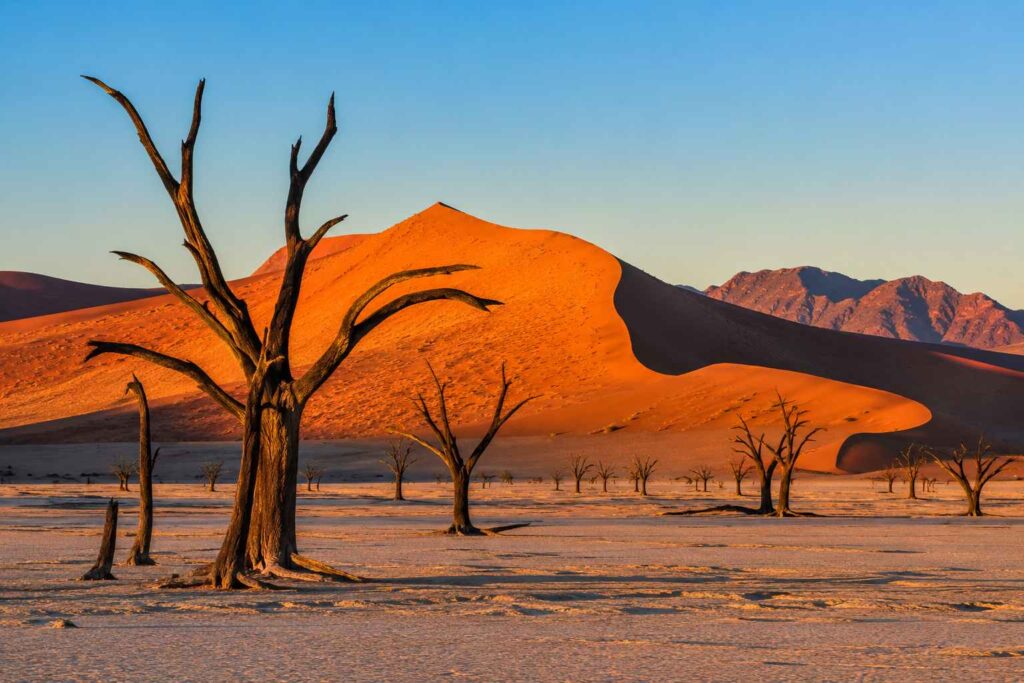
This white clay pan is famous for its ancient black camel thorn trees, many of which died hundreds of years ago after changing sand dunes blocked the river that once reached the basin.
The combination of:
- White clay
- Black tree skeletons
- Towering orange dunes
- Deep blue skies
creates one of the most striking natural landscapes anywhere on the planet.
For photographers, Deadvlei is simply unmissable.
Sesriem Canyon
While many visitors focus entirely on the dunes, Sesriem Canyon offers a completely different perspective.
Carved over millions of years by the Tsauchab River, the narrow canyon reaches depths of around 30 meters (100 feet) in places.
Walking through its cool, shaded passages provides welcome relief from the desert heat and offers fascinating insight into the geological history of the region.
The Naukluft Mountains
The eastern part of the park is dominated by the rugged Naukluft Mountains.
Unlike the sandy landscapes of Sossusvlei, this area features:
- Limestone cliffs
- Mountain plateaus
- Deep valleys
- Hiking trails
- Permanent springs
The mountains support wildlife rarely associated with deserts, including Hartmann’s mountain zebras, klipspringers, and baboons.
For active travelers, this is one of Namibia’s premier hiking destinations.
Desert wildlife
Although wildlife densities are lower than in Namibia’s famous safari parks, Namib-Naukluft supports an impressive variety of desert-adapted animals.
Species include:
- Gemsbok (oryx)
- Springbok
- Ostriches
- Black-backed jackals
- Brown hyenas
- Bat-eared foxes
- Cape foxes
- Hartmann’s mountain zebras
Smaller desert specialists such as geckos, lizards, insects, and snakes have evolved remarkable adaptations that allow them to survive in one of Earth’s harshest environments.
A paradise for photographers
Few places reward photographers like Namib-Naukluft.
Exceptional subjects include:
- Sunrise over giant dunes
- Deadvlei’s ancient trees
- Star-filled night skies
- Dramatic shadows
- Desert wildlife
- Mountain landscapes
Because of the dry air and minimal light pollution, the park is also outstanding for astrophotography.
The contrast between golden dunes and the Milky Way creates unforgettable images.
When is the best time to visit?
Namib-Naukluft can be visited throughout the year.
May to September
The cooler dry months offer:
- Pleasant daytime temperatures
- Cold mornings
- Clear skies
- Excellent hiking conditions
This is generally considered the most comfortable season.
October to April
Summer brings:
- Hot daytime temperatures
- Occasional thunderstorms
- Beautiful cloud formations
- Fewer visitors outside holiday periods
Early morning activities are especially important during the hottest months.
Self-drive or guided tour?
Namibia is one of Africa’s best self-drive destinations, and Namib-Naukluft is well suited to independent travelers.
Advantages of self-driving include:
- Flexible schedules
- Freedom to explore
- Scenic road trips
- Easy combination with other destinations
However, guided tours offer valuable local knowledge, particularly for photographers and first-time visitors unfamiliar with desert conditions.
Beyond the park
Many travelers combine Namib-Naukluft with:
- Swakopmund
- Walvis Bay
- Skeleton Coast
- Damaraland
- Etosha National Park
Together, these destinations showcase Namibia’s remarkable diversity—from towering dunes and dramatic coastlines to classic wildlife safaris.
Practical travel tips
To make the most of your visit:
- Enter the park early for sunrise.
- Carry plenty of drinking water.
- Wear sturdy walking shoes.
- Protect yourself from the sun.
- Bring a wide-angle lens for landscapes.
- Allow at least two or three days to explore.
The best light often occurs shortly after sunrise and before sunset, when the dunes glow with rich shades of orange and red.
Why Namib-Naukluft deserves more than a day trip
Many visitors rush through Sossusvlei before continuing elsewhere.
Those who stay longer discover a far richer destination.
The park rewards slow exploration with:
- Incredible geological diversity
- Peaceful hiking
- Exceptional photography
- Unique wildlife
- Some of Africa’s most dramatic landscapes
Its vastness is part of its magic.
Rather than simply ticking off famous dunes, take time to appreciate the many faces of this ancient desert.
Conclusion
Namib-Naukluft National Park is much more than a collection of giant sand dunes. While Sossusvlei and Deadvlei are rightly celebrated as some of the world’s most spectacular landscapes, the park also protects rugged mountains, ancient canyons, vast desert plains, and an extraordinary ecosystem shaped over millions of years.
Whether you’re climbing a towering dune at sunrise, hiking through the Naukluft Mountains, or photographing ancient trees beneath brilliant blue skies, every part of the park reveals a different side of Namibia’s remarkable natural heritage. Give yourself time to explore beyond the famous viewpoints, and you’ll discover why Namib-Naukluft is one of Africa’s most unforgettable destinations.
For more Namibia travel guides, self-drive itineraries, and African adventure inspiration, continue exploring the WhySafari blog.
FAQs
The park is best known for Sossusvlei, Deadvlei, and some of the world’s tallest sand dunes, but it also includes mountains, canyons, and diverse desert ecosystems.
Two to three days is ideal, allowing enough time to visit Sossusvlei, Deadvlei, Sesriem Canyon, and explore beyond the main tourist sites.
Yes. Although it’s not a traditional safari destination, you can see gemsbok, springbok, ostriches, jackals, Hartmann’s mountain zebras, and many desert-adapted smaller species.
Absolutely. Namibia is one of Africa’s best self-drive destinations, and the park is well equipped for independent travelers.
The cooler months between May and September generally provide the most comfortable temperatures for hiking and sightseeing.
No. Deadvlei is a separate clay pan located near Sossusvlei and can be reached by a short walk after the final parking area.
Yes. Many Namibia itineraries combine Namib-Naukluft, Swakopmund, Damaraland, and Etosha for a comprehensive road trip.