There are few places left in Africa where you can drive for hours without seeing another vehicle, camp beneath some of the world’s darkest skies, and encounter wildlife that has adapted to survive in one of the harshest environments on Earth. Kaokoland, in northwestern Namibia, is one of those rare places.
Remote, rugged, and breathtakingly beautiful, Kaokoland is not a traditional safari destination. You won’t find long queues of safari vehicles or densely populated game reserves. Instead, you’ll discover vast mountain ranges, dry river valleys, desert-adapted wildlife, and the rich cultural traditions of the Himba people.
For adventurous travelers, photographers, and experienced self-drive enthusiasts, Kaokoland represents one of Africa’s final frontiers—a place where the journey itself is every bit as rewarding as the destination.
Where is Kaokoland?
Kaokoland occupies the remote northwestern corner of Namibia, stretching from the Skeleton Coast inland to the Kunene River, which forms the border with Angola.
The region lies north of Damaraland and west of Etosha National Park, encompassing an immense landscape of:
- Rugged mountains
- Dry riverbeds
- Gravel plains
- Rocky valleys
- Desert plateaus
Unlike a national park, Kaokoland is a geographical region made up of communal conservancies, protected wilderness, and traditional settlements.
Its isolation has helped preserve both its landscapes and cultural heritage.
Why Kaokoland feels so untouched
Kaokoland remains one of southern Africa’s least-developed travel destinations.
Several factors contribute to its wilderness character:
- Remote location
- Limited road infrastructure
- Sparse population
- Few accommodation options
- Vast protected landscapes
Even during the busiest travel months, it’s entirely possible to spend an entire day exploring without encountering another tourist.
This sense of solitude is one of the region’s greatest attractions.
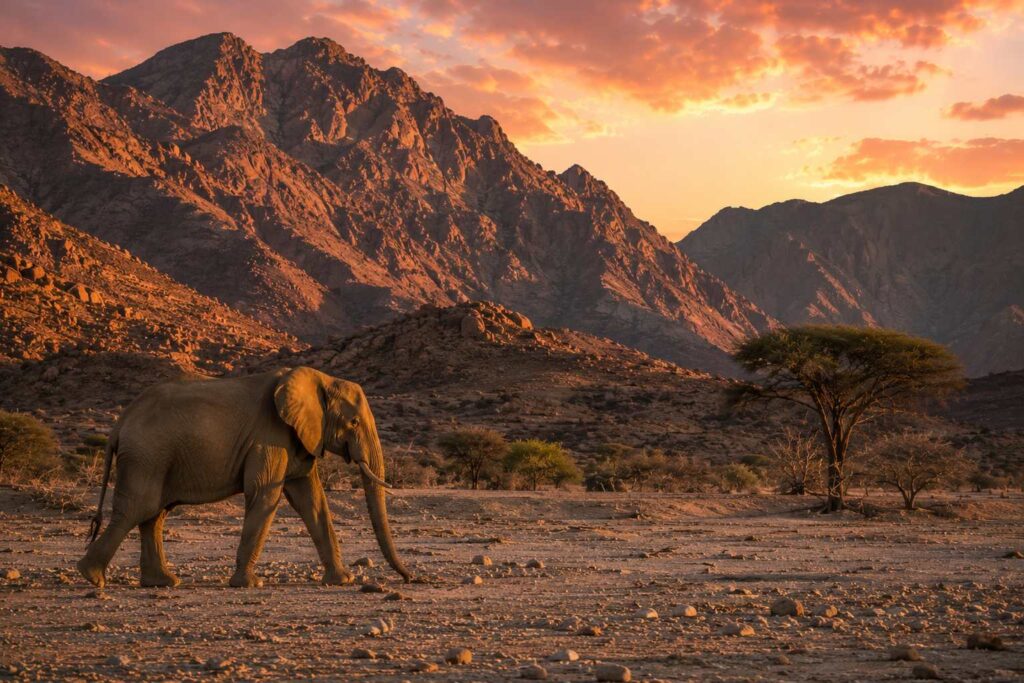
Desert-adapted elephants
Kaokoland is one of the best places in the world to observe desert-adapted elephants.
These remarkable animals are African elephants that have gradually adapted to life in an arid environment by:
- Traveling long distances between water sources
- Feeding on hardy desert vegetation
- Moving through dry riverbeds
- Conserving energy during extreme heat
Unlike elephants in more fertile ecosystems, they often appear in smaller family groups spread across vast landscapes.
Finding them requires patience, but the reward is extraordinary.
Other wildlife
Although Kaokoland is not a traditional high-density safari destination, it supports an impressive range of desert wildlife.
Species include:
- Giraffes
- Gemsbok (oryx)
- Springbok
- Greater kudu
- Hartmann’s mountain zebras
- Black rhinos
- Brown hyenas
- Black-backed jackals
Lions occasionally move through parts of the region, particularly along wildlife corridors connecting neighboring conservation areas.
Wildlife viewing here is less about numbers and more about witnessing remarkable adaptations to an unforgiving environment.
The Himba people
Kaokoland is also the ancestral homeland of the Himba, one of Africa’s best-known semi-nomadic pastoral communities.
Many visitors choose to learn about Himba culture through respectful, community-based experiences that provide insight into:
- Traditional homesteads
- Livestock herding
- Daily life
- Crafts
- Cultural customs
Responsible tourism is essential, ensuring visits are arranged with local communities in ways that support cultural preservation and provide meaningful economic benefits.
Approaching these experiences with curiosity and respect creates far more rewarding interactions than treating them as photographic opportunities alone.
Spectacular landscapes
Kaokoland’s scenery is every bit as memorable as its wildlife.
Highlights include:
- The Marienfluss Valley
- Hartmann Valley
- Kunene River
- Remote mountain passes
- Dry riverbeds lined with ana trees
- Endless desert horizons
The changing light transforms the landscape throughout the day, making every drive feel different.
For landscape photographers, Kaokoland is among Namibia’s finest destinations.
The Kunene River
Flowing along Namibia’s northern border, the Kunene River provides a striking contrast to the surrounding desert.
Its lush banks attract:
- Crocodiles
- Birdlife
- Desert wildlife
- Local communities
The river also creates opportunities for scenic drives and peaceful overnight stays in remote riverside lodges.
After days of exploring dry landscapes, the sudden appearance of permanent water feels almost surreal.
A paradise for self-drive adventures
Kaokoland is one of Africa’s ultimate overland destinations.
However, it’s best suited to experienced travelers.
Road conditions often include:
- Deep sand
- Rocky tracks
- River crossings
- Remote mountain passes
A high-clearance four-wheel-drive vehicle is essential.
Because services are extremely limited, careful planning is vital.
Travelers should carry:
- Extra fuel
- Drinking water
- Recovery equipment
- Spare tires
- Navigation tools
Preparation is part of the adventure.
Birdwatching
Although wildlife often steals the spotlight, Kaokoland also supports excellent birdlife.
Notable species include:
- Verreaux’s eagle
- Rosy-faced lovebird
- Monteiro’s hornbill
- Ostriches
- Bee-eaters
- Raptors
The Kunene River and seasonal watercourses are particularly rewarding for birdwatchers.
When is the best time to visit?
The dry season between May and October is generally considered the most comfortable period.
Visitors enjoy:
- Mild daytime temperatures
- Cooler nights
- Easier travel conditions
- Pleasant hiking weather
Summer months can be extremely hot, although occasional rainfall briefly transforms parts of the landscape.
Because wildlife is never concentrated in large numbers, timing is less critical than in many traditional safari destinations.
Accommodation
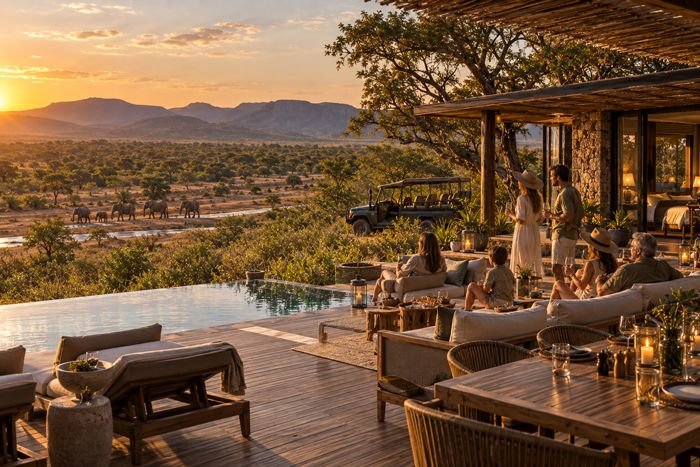
Accommodation reflects the region’s remote nature.
Options include:
- Eco-lodges
- Remote safari camps
- Wilderness campsites
- Boutique desert lodges
Many properties focus on sustainability while maintaining a minimal environmental footprint.
Some of Namibia’s finest stargazing can be enjoyed directly from these remote camps.
Who should visit Kaokoland?
Kaokoland is ideal for travelers who:
- Enjoy remote wilderness.
- Have previous safari experience.
- Love landscape photography.
- Appreciate cultural travel.
- Prefer self-drive adventures.
- Seek destinations far from the crowds.
Those expecting constant wildlife sightings may find Etosha more suitable.
Kaokoland rewards patience, curiosity, and a spirit of exploration.
Combining Kaokoland with other destinations
Many visitors include Kaokoland as part of a longer Namibia itinerary alongside:
- Etosha National Park
- Damaraland
- Skeleton Coast
- Epupa Falls
- Namib-Naukluft National Park
This combination showcases Namibia’s remarkable diversity, from classic safari experiences to some of Africa’s most remote wilderness.
Practical travel tips
Before visiting:
- Rent a reliable 4WD vehicle.
- Download offline navigation.
- Carry emergency supplies.
- Inform someone of your planned route.
- Fill fuel tanks whenever possible.
- Allow extra travel time.
Distances are deceptive, and driving conditions are often slower than expected.
Why Kaokoland is one of Africa’s last great wilderness areas
Few destinations remain as untouched as Kaokoland.
Its immense landscapes, resilient wildlife, living cultural traditions, and extraordinary isolation create an experience that feels increasingly rare in today’s world.
Rather than rushing from attraction to attraction, Kaokoland encourages travelers to slow down, embrace uncertainty, and appreciate the simple privilege of exploring one of Africa’s last truly wild places.
Conclusion
Kaokoland is one of Namibia’s most extraordinary regions, offering an adventure unlike any traditional safari. Its desert-adapted elephants, dramatic mountain landscapes, remote river valleys, and rich Himba culture combine to create a journey defined by exploration rather than checklists.
For travelers willing to venture beyond the country’s better-known attractions, Kaokoland delivers solitude, authenticity, and a profound connection with one of Africa’s last great wilderness areas. It’s not simply a destination—it’s an experience that stays with you long after the journey ends.
For more Namibia travel guides, self-drive itineraries, and African adventure inspiration, continue exploring the WhySafari blog.
FAQs
Kaokoland is located in northwestern Namibia, between Damaraland, the Skeleton Coast, and the Kunene River along the Angolan border.
The region is known for desert-adapted elephants, rugged wilderness, Himba culture, remote mountain landscapes, and exceptional self-drive adventures.
Yes. Visitors may encounter desert-adapted elephants, black rhinos, giraffes, gemsbok, mountain zebras, brown hyenas, and many other desert-adapted species.
Yes. A high-clearance four-wheel-drive vehicle is essential due to sandy tracks, rocky roads, and remote driving conditions.
It can be, but it’s generally better suited to experienced self-drive travelers or those visiting with an organized guided safari because of its remoteness.
Yes, through responsible community-based visits that respect local customs and directly benefit Himba communities.
Three to five days allows enough time to explore several valleys, search for wildlife, and appreciate the region’s remarkable landscapes without rushing.