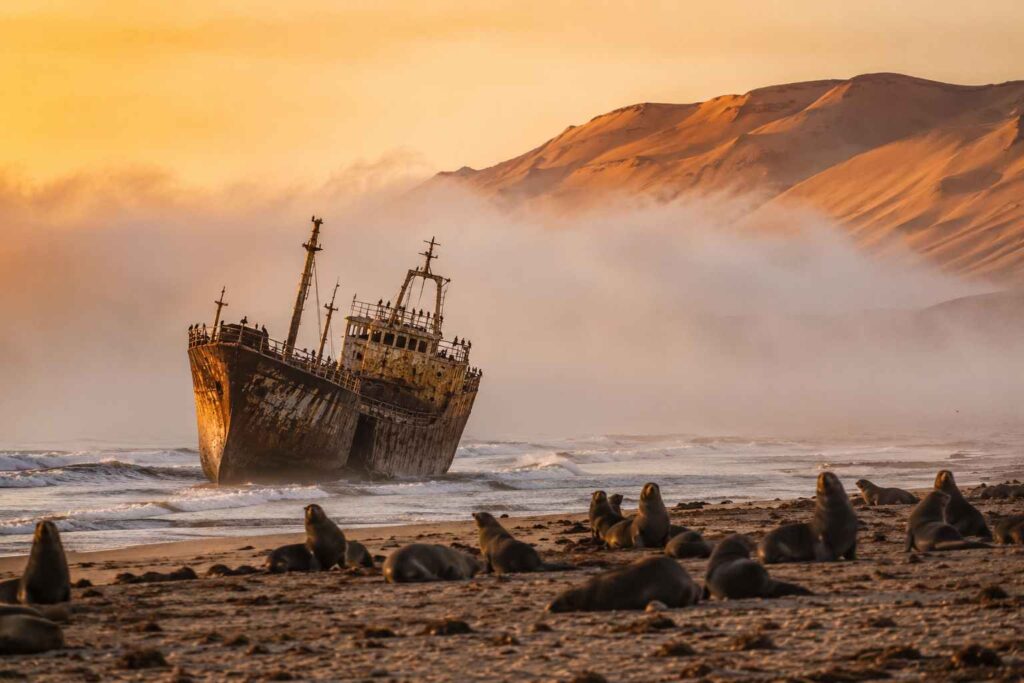
Few places on Earth evoke as much mystery as Skeleton Coast National Park. Stretching along Namibia’s remote Atlantic shoreline, this hauntingly beautiful landscape is where towering sand dunes meet the cold Atlantic Ocean, dense sea fog drifts across the desert, and rusting shipwrecks tell stories of sailors who once called it “The Gates of Hell.”
Despite its dramatic reputation, the Skeleton Coast is far more than a graveyard of abandoned ships. It is one of Africa’s most remarkable protected areas, home to uniquely adapted wildlife, spectacular coastal scenery, and one of the continent’s last truly untouched wilderness regions.
For adventurous travelers seeking something beyond the traditional safari, Skeleton Coast National Park offers an unforgettable journey into one of the world’s most extraordinary landscapes.
Where is Skeleton Coast National Park?
Skeleton Coast National Park occupies Namibia’s northwestern Atlantic coastline.
The park stretches for approximately 500 kilometers (310 miles), from the Ugab River in the south toward the Kunene River on the border with Angola.
It forms a vital link between:
- The Namib Desert
- Damaraland
- Kaokoland
- The Atlantic Ocean
Its remote location has helped preserve an extraordinary sense of isolation that few destinations in Africa can match.
Why is it called the Skeleton Coast?
The coastline earned its name from two different kinds of “skeletons.”
The first were the bones of whales left behind after centuries of whaling.
The second were the remains of countless shipwrecks.
Dense fog, unpredictable currents, rough seas, and shifting sandbanks created one of the world’s most dangerous coastlines for navigation.
Many vessels became stranded here, leaving behind rusting hulls that remain scattered along the shore today.
These haunting relics have become one of the region’s defining features.
A meeting of desert and ocean
The Skeleton Coast is one of the few places where an ancient desert meets a cold ocean.
The frigid Benguela Current flowing northward along the Atlantic coast produces:
- Dense morning fog
- Cool coastal temperatures
- Rich marine ecosystems
- Dramatic atmospheric conditions
This fog is far more than a scenic phenomenon.
It provides a vital source of moisture for plants, insects, and animals living in an environment that receives very little rainfall.
Wildlife on the Skeleton Coast
Although the landscape appears harsh, it supports a surprising diversity of wildlife.
Animals found here include:
- Desert-adapted elephants
- Brown hyenas
- Black-backed jackals
- Giraffes
- Oryx (gemsbok)
- Springbok
- Ostriches
Many species survive by exploiting seasonal riverbeds and fog-generated moisture.
The ability of wildlife to thrive in such an unforgiving environment is one of the park’s greatest wonders.
Cape fur seal colonies
One of the Skeleton Coast’s most famous wildlife spectacles is its enormous Cape fur seal colonies.
At locations such as Cape Fria and nearby coastal breeding sites, thousands of seals gather throughout the year.
These colonies attract predators including:
- Brown hyenas
- Black-backed jackals
- Occasionally lions in the broader coastal ecosystem
- Numerous seabirds
The sounds, smells, and constant movement create one of Namibia’s most memorable wildlife experiences.
Birdlife
The meeting of ocean, wetlands, and desert attracts an impressive variety of birds.
Common species include:
- Cormorants
- Flamingos
- Pelicans
- Terns
- Gulls
- Oystercatchers
- Damara terns
Birdwatchers particularly appreciate the seasonal wetlands and coastal lagoons farther south.
Shipwrecks and maritime history
Perhaps no feature symbolizes the Skeleton Coast more than its abandoned shipwrecks.
Among the best-known are:
- The Eduard Bohlen
- Zeila
- Smaller wrecks scattered along remote beaches
Some lie stranded far inland due to shifting sand dunes, illustrating how dynamic the coastline has been over time.
These weathered vessels provide fascinating photographic subjects and reminders of the coastline’s formidable natural forces.
The landscapes
The scenery constantly changes.
Visitors encounter:
- Endless beaches
- Giant sand dunes
- Rocky shorelines
- Gravel plains
- Dry river mouths
- Coastal fog banks
This remarkable variety makes every section of the coastline feel different.
The sense of scale is almost impossible to capture until experienced in person.
How do you visit?
The park has different access zones.
Southern section
Accessible by road and popular with self-drive travelers exploring Namibia.
Northern section
Highly restricted.
Access is generally limited to:
- Guided fly-in safaris
- Authorized expeditions
- Special permits
These restrictions help protect one of Africa’s most fragile wilderness ecosystems.
When is the best time to visit?
Skeleton Coast can be visited throughout the year.
May to October
Visitors enjoy:
- Mild daytime temperatures
- Cooler weather
- Comfortable exploration
- Clear skies inland
November to April
Conditions become warmer inland, although the cold Atlantic continues to moderate coastal temperatures.
Fog remains a defining feature during much of the year.
Rather than being an inconvenience, it contributes greatly to the region’s unique atmosphere.
Photography opportunities
Skeleton Coast is a paradise for photographers.
Highlights include:
- Shipwrecks
- Coastal fog
- Desert landscapes
- Seal colonies
- Dramatic skies
- Minimal light pollution for astrophotography
The constantly changing weather creates fresh photographic opportunities throughout the day.
Sunrise and sunset are particularly spectacular as light interacts with fog and sand.
Combining Skeleton Coast with other destinations
Skeleton Coast fits naturally into a broader Namibia itinerary.
Popular combinations include:
- Swakopmund
- Damaraland
- Etosha National Park
- Namib-Naukluft National Park
- Kaokoland
Together, these regions showcase Namibia’s extraordinary diversity, from wildlife-rich savannahs to ancient deserts and remote coastlines.
Practical travel tips
Before visiting:
- Pack warm layers despite the desert setting.
- Bring binoculars.
- Protect cameras from sand.
- Carry drinking water.
- Expect limited mobile reception.
- Allow flexibility for changing weather.
The coastline rewards travelers willing to embrace its wild and unpredictable character.
Why Skeleton Coast is unlike anywhere else
Many safari destinations are defined by abundant wildlife.
Skeleton Coast is defined equally by atmosphere.
It’s a place where silence, mist, crashing waves, shifting dunes, and endless horizons create an emotional connection that goes beyond traditional sightseeing.
Here, the landscape itself becomes the main attraction.
Wildlife, shipwrecks, and history simply add further layers to an already unforgettable experience.
Conclusion
Skeleton Coast National Park is one of Africa’s most extraordinary wilderness destinations. Its collision of desert and ocean, haunting shipwrecks, thriving seal colonies, and resilient desert wildlife create a landscape unlike anywhere else on the continent. Rather than offering a traditional safari focused solely on game viewing, it invites travelers to experience nature in its rawest and most dramatic form.
For those seeking adventure, solitude, and some of Namibia’s most unforgettable scenery, the Skeleton Coast delivers an experience that is every bit as captivating as the country’s famous dunes and wildlife parks.
For more Namibia travel guides, safari inspiration, and self-drive itineraries, continue exploring the WhySafari blog.
FAQs
The name comes from whale bones that once lined the shore and the many shipwrecks left behind after vessels were stranded by fog, currents, and rough seas.
Yes. Visitors may encounter desert-adapted elephants, brown hyenas, jackals, oryx, springbok, ostriches, and large Cape fur seal colonies.
No. The southern section is accessible by road, while the remote northern section generally requires authorized guided tours or fly-in safaris.
The cooler months from May to October provide comfortable conditions, although the Skeleton Coast can be visited year-round.
Yes, but mainly in the southern section of the park. The northern areas have strict access controls to protect the fragile environment.
The Eduard Bohlen is one of the best-known shipwrecks, famous for sitting surprisingly far inland after decades of shifting sand dunes.
Two to three days is ideal, especially when combined with Swakopmund or Damaraland as part of a wider Namibia itinerary.